Our verdict: Nice to have
Hot tub ozone vs UV-C
Short answer
Ozone and UV-C both cut how much chlorine a hot tub needs; neither replaces it. Ozone is standard on 205 of the 390 hot tubs we track and UV-C on 49, by the makers' own spec sheets.
Nice to haveOzone
Count ozone as a wear part, and don't pay much extra for it. It stretches chlorine but can't replace it, and it fails quietly: DEL, a spa ozone maker, says to replace units after about 3 years. A glowing bulb doesn't prove it still makes ozone.
Nice to haveUV-C lights
Take UV if it's standard, but don't pay extra for it. It leaves nothing in the water, so you still need chlorine. Bulbs are a running cost: $68 to $90 a year for Jacuzzi's ClearRay, and about $240 for Dimension One's, which D1 says to replace every 18 months.
What does a hot tub ozonator do?
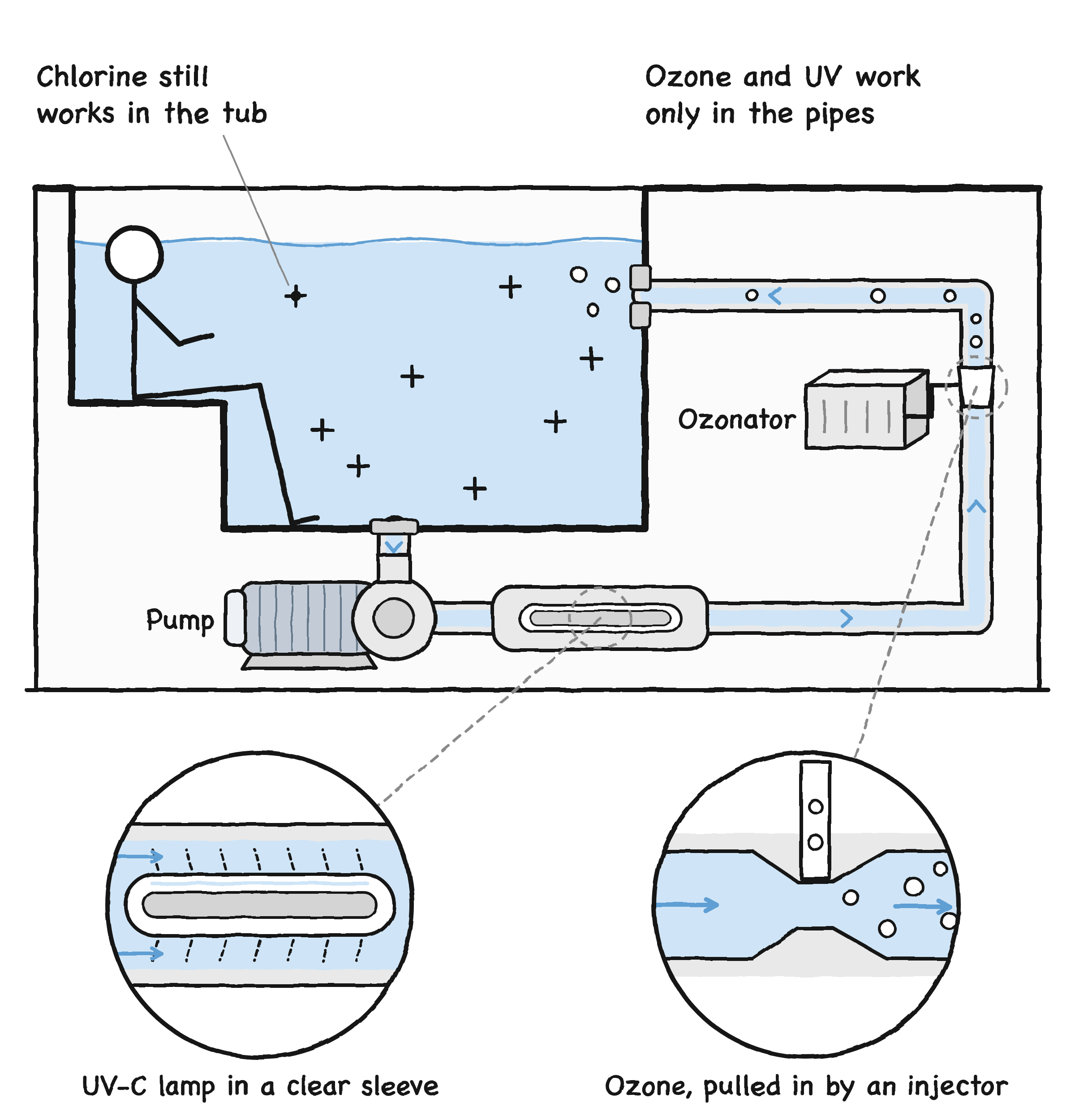
An ozonator turns oxygen in the air into ozone, either with a small UV bulb or with a corona-discharge chip that passes the air through a high-voltage field. A venturi injector then pulls the gas into the plumbing. Ozone is a strong oxidizer: it breaks apart body oils, lotions and germs on contact, then decays back to oxygen within minutes. Most of the work happens at the injector and in the return lines, so PHTA, the industry's trade body, says only about 0.1 ppm may reach the seats. A 2025 review of pool and spa disinfection found corona discharge runs in more than 90% of ozonators.
Some brands treat ozone as basic equipment. Marquis lists a corona-discharge ozonator with a Mazzei injector on every series. PDC fits ozone to every tub and adds a cabinet light that shows the ozonator is running. That light matters, because an ozonator fails quietly: the water just needs more chlorine than it used to.
What does a UV-C system do?
A UV-C system is a lamp sealed in a clear sleeve inside the plumbing. Water flowing past gets a dose of short-wave light that scrambles the DNA of bacteria and parasites so they can't multiply. It treats only the water passing the lamp at that moment. How well it works depends on lamp output, water clarity and flow rate, and some germs need far higher doses than others. Jacuzzi's ClearRay, standard on its J-200 and J-300 tubs, uses a 10 W low-pressure lamp that Jacuzzi says to replace every 12 months.
Do ozone or UV replace chlorine?
No. Neither one leaves anything working in the tub once the water moves on, and the tub is where people sit. CDC's model aquatic code notes that UV leaves no lasting residual. The NSF/ANSI 50 standard requires UV and ozone units to be used with an EPA-registered sanitizer such as chlorine or bromine. CDC's hot tub guidance for Legionella, the germ behind most hot tub outbreaks, relies on a disinfectant residual, pH control and filter care.
What they do is lower the chlorine dose. Jacuzzi cites its own lab testing for up to 50% less sanitizer with ClearRay. Treat any figure like that as the maker's claim: the EPA classes both ozonators and UV units as pesticide devices, which are not reviewed for effectiveness before they are sold.
Ozone or UV: which should you look for?
They do different jobs, which is why several makers pair them. Ozone attacks oils and other organic waste; UV-C knocks out germs that pass the lamp, including parasites that shrug off chlorine. Jacuzzi's and Sundance's ClearRay Active Oxygen and Dimension One's UltraPure Plus run both in one unit. In the table above, 5 brands put ozone on every model (Jacuzzi, Marquis, Master Spas, PDC Spas, Sundance Spas); only Sundance Spas puts UV-C on every model.
Both are wear parts. DEL, which makes spa ozonators, says to replace one after about 3 years. UV lamps go every 12 months on ClearRay and every 18 months on Dimension One's unit, by D1's own page. Take either one when it comes standard, ask what the replacement part costs, and don't pay much extra for it. If you want to run less chlorine still, look at salt water hot tubs and mineral cartridges, which work in different ways. For the sanitizer levels to keep alongside either one, see hot tub chlorine levels and chlorine vs bromine.
What to ask the dealer
- When does the ozonator need replacing, and what does that cost?
- Does ozone run all day, or only during filter cycles?
- How will I know it's still working?
- Does the UV lamp run all day, or only during filter cycles?
- What does a new bulb cost, and is it under warranty?
- How much chlorine do I still need with it running?
The details
Which brands offer it, the research behind the verdict, and the sources.
Which brands offer it
15 brands
Ozone standard
205 of 390
UV-C standard
49 of 390
Brands with ozone on every model
5
| Jacuzzi | All modelsClearRay Active Oxygen | Some modelsClearRay Active Oxygen |
|---|---|---|
| Marquis | All modelsCorona-discharge ozonator with Mazzei injection | Not listed |
| Master Spas | All modelsOzone | Not listed |
| PDC Spas | All modelsEverPure ozone with EverLite indicator, EverPure2 | OptionalEverPure2 |
| Sundance Spas | All modelsClearRay Active Oxygen | All modelsClearRay Active Oxygen, CLEARRAY On-Demand |
| Artesian Spas | Some modelsOzone Ready / Ozonator, Crystal ProPure Ozone Mixing Chamber | OptionalDiamond AOP |
| Bullfrog Spas | Some modelsEOS O3 Enhanced Ozone, WellSpring O3 / High-Output Ozone | Not listed |
| Cal Spas | Some modelsPure Silk Ozone System, Twin Pure Silk Ozone System | Some modelsPure Cure UV Purification System |
| Hot Spring | Some modelsFreshWater III high-output ozone | Not listed |
| Nordic Hot Tubs | Some modelsNordic CLEAN | OptionalNordic PURE |
| Wellis | Some modelsOzmix ozone | Not listed |
| American Whirlpool | OptionalCleanZone System | OptionalCleanZone Ultra Dual Sanitization System |
| Caldera Spas | OptionalCorona-discharge ozone | Not listed |
| Dimension One Spas | OptionalClearZone PRO | Some modelsUltraPure Plus Water Management System |
| Vita Spa | OptionalCleanZone | OptionalCleanZone Ultra |
What the research says
24 findings
Ozone
- Government CDC's model code rationale says ozone is proven to kill Cryptosporidium, Giardia, E. coli and Pseudomonas aeruginosa and is a strong oxidizer, and treats it as a secondary treatment that works alongside a residual disinfectant.
- Trade PHTA says ozone oxidizes organics and breaks down chloramines mostly at the injection point and in the return lines, that only a small residual (about 0.1 ppm) may reach the water, and that it must be used with an EPA-registered sanitizer.
- Study A 2025 peer-reviewed review reports corona discharge is used in more than 90% of ozonators and is more energy-efficient than UV generation, which makes lower concentrations. It credits ozone with cutting chlorine demand and notes its short half-life means it cannot be the primary disinfectant.
- Maker DEL, a spa ozone maker, says spa ozonators wear out and recommends replacement after about 3 years, rating its newer MCD-50 at up to 5 years in normal use.
- Technician A dealer technical guide puts standard UV ozonators at 1.5 to 3 years and CD-chip units at about 9,000 operating hours, notes that a glowing UV bulb does not prove ozone is being made, and names failed check valves and clogged injectors as common faults.
- Government EPA classes ozone generators as pesticide devices: they are not registered or reviewed for efficacy before sale.
- Maker Marquis lists an ozonator as standard on every series and offers no UV system.
- Maker PDC injects ozone whenever its pump filters and adds an EverLite cabinet light confirming the ozonator works.
UV-C lights
- Government The CDC's model code rationale states that although UV is a disinfectant, it does not leave a lasting disinfecting residual in the water.
- Government The same CDC model-code rationale notes that even 100% UV treatment of recirculated water does not make bathers safe right after a contamination event; it only shortens the time for the system to dilute pathogens below an infective dose.
- Trade PHTA says UV is used in public aquatics because some pathogens resist halogen sanitizers like chlorine, and UV can inactivate them, including Cryptosporidium and Giardia, in a single pass through the reactor.
- Trade Under NSF/ANSI 50, a UV unit rated as secondary disinfection must achieve a 3-log (99.9%) Cryptosporidium reduction per pass at its maximum flow, and all UV and ozone systems must still be used with an EPA-registered residual sanitizer such as chlorine or bromine.
- Trade PHTA notes UV dose depends on lamp output, water clarity and flow rate, that different germs need very different doses (protozoa and some viruses need far more than bacteria), and that the common cold virus is resistant to UV but easily killed by chlorine or bromine.
- Standard In September 2026, NSF's certified UV equipment listing showed 16 manufacturers, all pool-equipment makers such as Hayward, Pentair, Zodiac and Evoqua; no hot tub brand appeared as a listed manufacturer.
- Government EPA treats UV units as pesticide devices: they are not registered or reviewed for efficacy before sale, and an EPA establishment number on the label does not mean EPA approved the product.
- Maker Jacuzzi's ClearRay FAQ describes a 10 W low-pressure UV-C bulb that must be replaced every 12 months, says a residual sanitizer is still required, and cites the company's own lab testing for up to 50% less sanitizer. It cites UL, TUV and ETL listings, which cover electrical safety.
- Government CDC's guidance on controlling Legionella in hot tubs (the pathogen behind most hot tub outbreaks) relies on disinfectant residual, pH, scrubbing biofilm and filter care, and does not list UV as a control measure.
- Government In CDC surveillance of treated-recreational-water outbreaks for 2015-2019, 70% of hotel and resort outbreaks were tied to hot tubs, and 72% of those with a confirmed cause were Legionella from a hot tub. Legionella is controlled mainly by residual disinfectant and cleaning.
- Study A 2025 peer-reviewed review of pool and spa disinfection lists UV's drawbacks as no residual, reduced effect in cloudy water, and lamps that fog and lose output and need yearly replacement; it also credits UV with reducing chlorine demand and combined chlorine.
- Maker Jacuzzi's J-215 comes with ClearRay as standard and lists no circulation pump.
- Trade An independent store sells the ClearRay XL bulb for 2012-on Jacuzzi and Sundance tubs at $68.
- Trade A Jacuzzi dealer's store sells the same ClearRay bulb for $89.99.
- Trade A parts store lists Dimension One's UltraPure Plus lamp at $239, noting it can stay lit after ozone output fades.
- Trade Another store sells the same lamp for $245.99 and rates it for 18 to 24 months.
Common questions
Is ozone or UV better for a hot tub?
Neither replaces chlorine, and they do different jobs. Ozone breaks down oils and organic waste; UV-C inactivates germs as they pass the lamp. Several makers combine the two in one unit.
Do I still need chlorine with an ozonator or UV system?
Yes. NSF/ANSI 50 requires UV and ozone units to be used with an EPA-registered sanitizer, because neither leaves a lasting residual in the water where people sit.
How long does a hot tub ozonator last?
DEL, a spa ozone maker, recommends replacing an ozonator after about 3 years and rates its newer MCD-50 at up to 5 years in normal use.
How often does a hot tub UV bulb need replacing?
Jacuzzi says its ClearRay lamp needs replacing every 12 months. Dimension One says to replace its UltraPure lamp every 18 months.
Sources
8
- PHTA: ozone and UV in spas (NSF/ANSI 50 requirements)
- PHTA: UV dose and germs
- CDC Model Aquatic Health Code annex, 2023
- CDC Legionella control toolkit: hot tubs
- EPA: pesticide devices, a guide for consumers
- Jacuzzi ClearRay FAQ
- DEL Ozone: spa ozonators
- Peer-reviewed review of pool and spa disinfection, 2025
Ten questions, three tubs that fit you.
Take the 2-minute quizWhat a good deal looks like, then one dealer near you.
Get the price range