Our verdicts: Worth paying for, depends on you
Hot tub jets and pump power
Short answer
Pump power behind your seat matters more than the jet count. The median hot tub we track has 43 jets on 2 pumps, about 22 jets per pump, and 5 continuous horsepower in total.
Worth paying forPump horsepower
Ignore the big horsepower number; ask for continuous HP or amps, then feel the jets in your seat with the back of your hand on a running display. Cal Spas prints only brake horsepower; its 6.0 BHP replacement pump is sold as 4 HP continuous. Marquis's 480 GPM just adds two 240 GPM pumps.
Depends on youJet count
Pay for pump power behind the seats you'll use, not for the jet count. Counts aren't comparable: one Beachcomber FlexJet insert holds up to seven jets, and PDC's 143-jet Bali counts 73 air holes. Divide jets by pumps; Sundance suggests 20 to 30 per pump.
How do hot tub jets work?
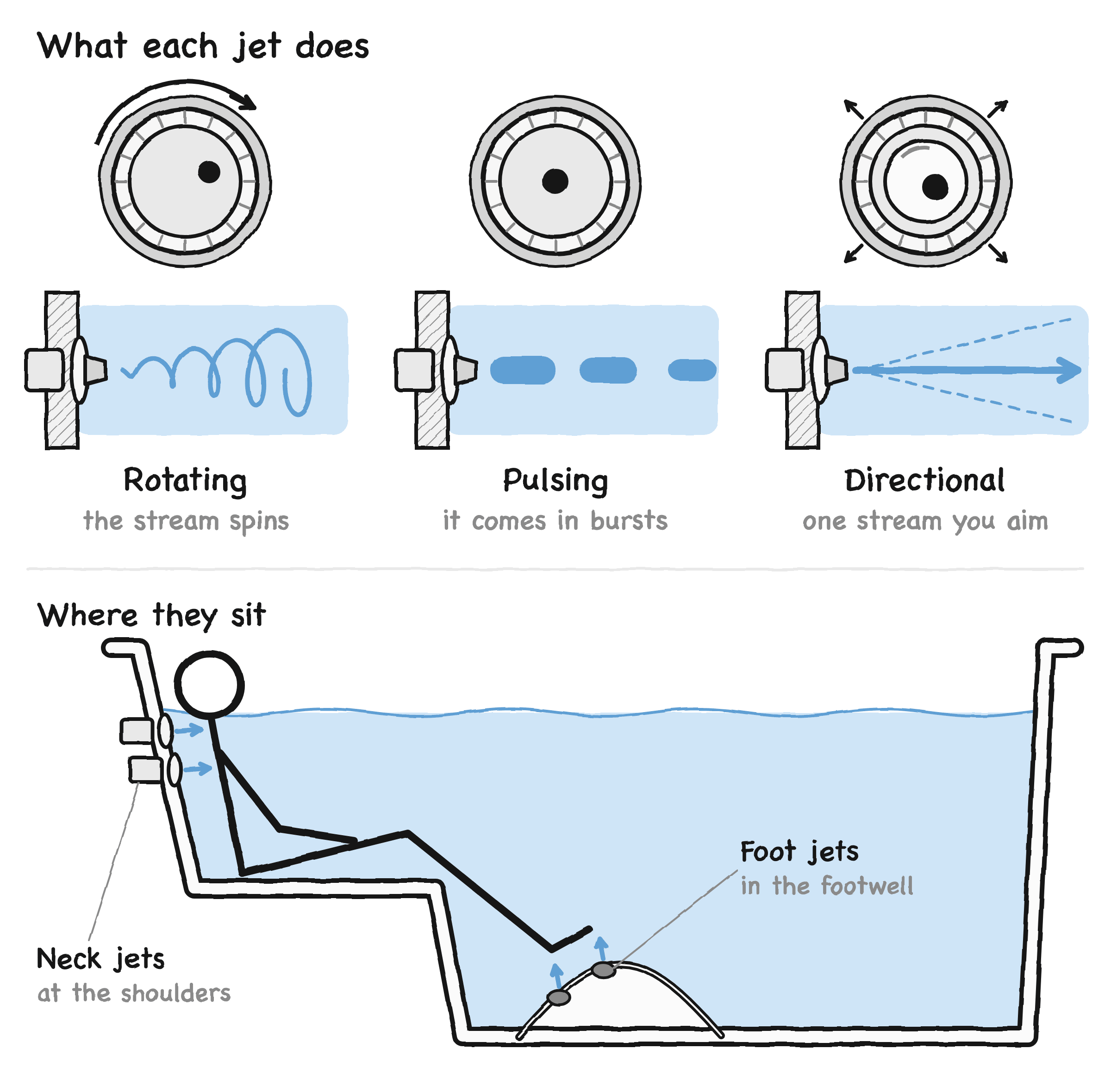
A jet is a nozzle fed by a pump. The pump pushes water into a pipe that branches out to every open jet in its zone, and each jet takes a share of that flow. Many jets also pull in air through a venturi, which makes the stream feel harder. Open more jets on the same pump and each one gets less water, so it pushes less. That is why Sundance suggests roughly 20 to 30 jets per therapy pump and says 50 jets on two dedicated pumps usually feel stronger than 100 jets sharing one modest pump. Across the tubs we track the median is 22 jets per pump.
Brands don't count jets the same way, either. PDC's Bali lists 143 jets, but 73 of them are air outlets, not water jets. Bullfrog builds its massage into removable JetPak seat backs, each with its own valve, so the count says little about how a given seat feels. More jets also cost energy: California's Energy Commission notes that extra jets need more pumping power and add hoses that shed heat into the cabinet.
What is brake horsepower vs continuous horsepower?
Brake horsepower is the peak a motor reaches for a moment on a test stand. Continuous horsepower is what it can hold all day: one industry guide puts a 3 BHP motor at about 1.5 HP continuous. Century, a major spa motor maker, shows how the big numbers are built: on its chart a motor sold as 4.0 “SPL” is a 3.0 HP motor, and a 2.0 SPL is 1.5 HP. A parts retailer's guide suggests comparing the amps on the motor label instead, because amps can't be inflated.
Brands print very different numbers for the same kind of motor. Cal Spas lists only brake horsepower, such as three 6.0 BHP pumps on the LaJolla, and a parts store sells that 6 BHP pump as 4 HP continuous duty. Marquis prints gallons per minute and no horsepower: its two-pump Crown Epic is 480 GPM, exactly twice the one-pump Crown Spirit.
How many jets does a hot tub need?
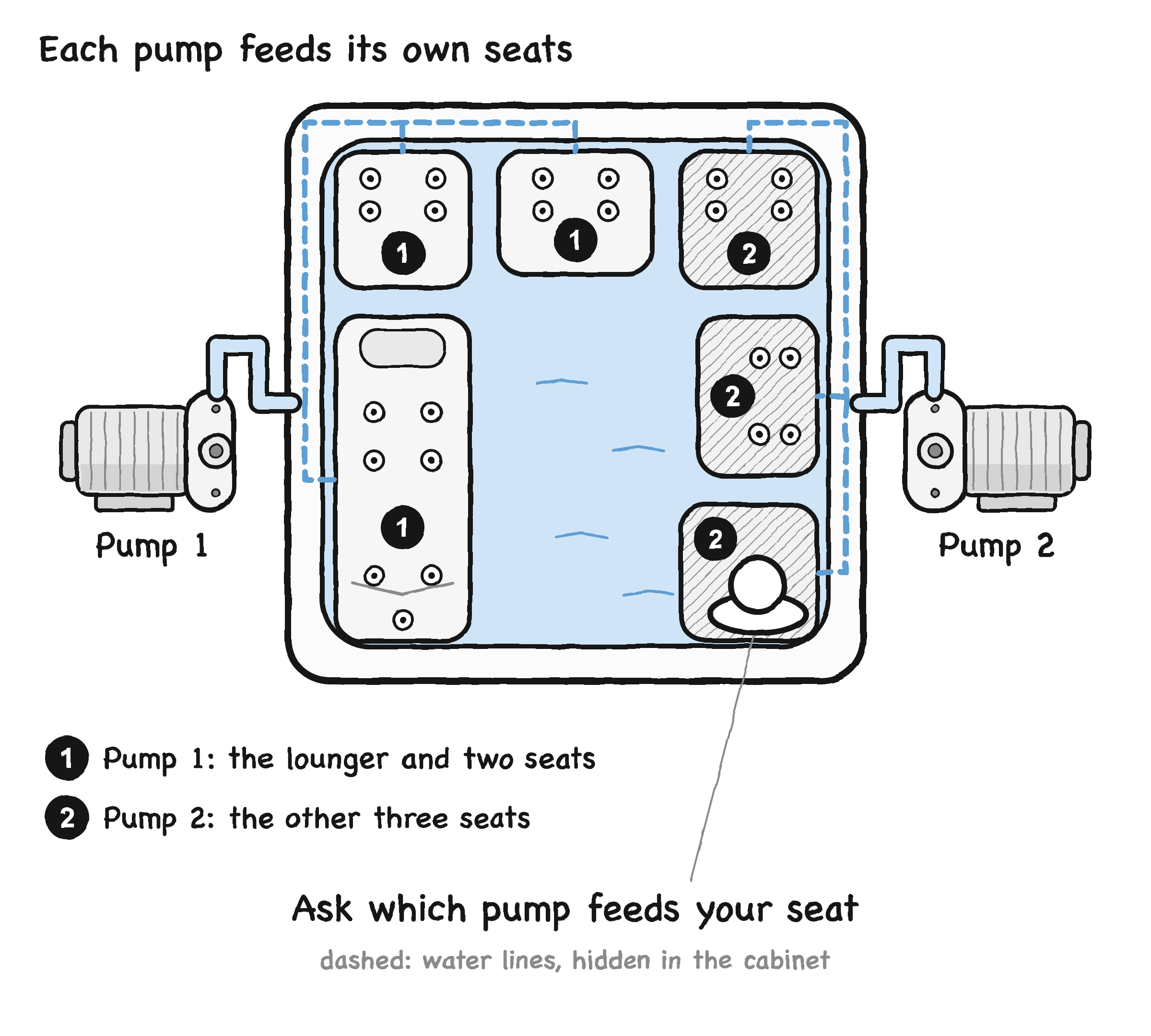
Fewer than the brochure suggests, as long as enough pump sits behind the seat you will use. Count the pumps, divide the jets by them, and ask which pump feeds your favorite seat. Then sit in that seat on a display to see where the jets line up, and feel their pressure with the back of your hand on a running tub. How the jets are plumbed matters too: see manifold vs daisy-chain plumbing. If massage strength is the main reason you are buying, start with the best hot tubs for back pain.
What to ask the dealer
- Is that brake or continuous horsepower, and what does each motor draw in amps?
- How many pumps feed my seat, and how many jets share them?
- Can I see this model running, so I can feel the jets in my seat?
- Which pump runs this seat, and how many other jets share it?
- How many of these jets are water jets, and how many are air?
- Can I shut off jets to send more flow to my seat?
The details
Which brands offer it, the research behind the verdict, and the sources.
Which brands offer it
15 brands
Median jets
43
Median jets per pump
22
Median continuous HP
5
| American Whirlpool22 models | 1 to 4 | 45 | 622 of 22 models |
|---|---|---|---|
| Artesian Spas41 models | 1 to 5 | 50 | 438 of 41 models |
| Bullfrog Spas25 models | 1 to 3 | 47 | 2.42 of 25 models |
| Cal Spas57 models | 1 to 3 | 51 | 657 of 57 models |
| Caldera Spas23 models | 1 to 3 | 38 | 5.215 of 23 models |
| Dimension One Spas15 models | 1 to 3 | 41 | 515 of 15 models |
| Hot Spring24 models | 1 to 3 | 33 | 319 of 24 models |
| Jacuzzi19 models | 1 to 3 | 41 | 519 of 19 models |
| Marquis25 models | 1 to 2 | 41 | — |
| Master Spas29 models | 1 to 3 | 37 | — |
| Nordic Hot Tubs26 models | 1 to 2 | 23 | 226 of 26 models |
| PDC Spas14 models | 1 to 2 | 61 | 414 of 14 models |
| Sundance Spas19 models | 1 to 3 | 40 | 517 of 19 models |
| Vita Spa20 models | 1 to 3 | 47 | 620 of 20 models |
| Wellis31 models | 1 to 4 | 45 | — |
What the research says
16 findings
Pump horsepower
- Maker Century (Regal), a major pool and spa motor maker, tells buyers to compare total horsepower (nameplate HP × service factor), and its spa motor chart shows 'SPL' ratings overstate continuous horsepower. A 2.0 SPL motor is 1.5 HP, a 3.0 SPL motor is 2.0 HP, and a 4.0 SPL motor is 3.0 HP at 1.0 service factor.
- Maker The same Century catalog lists spa motors with their maximum load amps. For example, 3.0 SPL two-speed spa motors are rated around 10 A at 230 V on high, which gives a harder number to compare than advertised HP.
- Technician A pool-parts retailer's technical article explains that spa pumps use a service factor below 1.0 ('SPL') to inflate HP and recommends comparing amperage instead.
- Trade Brake HP is a short-term peak the motor can't sustain; one industry guide says a '3 BHP' motor is typically about 1.5 HP continuous.
- Maker Sundance suggests roughly 20-30 jets per therapy pump and says 50 jets on two dedicated pumps typically feels stronger than 100 jets sharing one modest pump.
- Government The California Energy Commission notes that more jets increase pumping power demand and add hoses that lose heat to the cabinet.
- Maker Cal Spas spec tables give pump power only in brake horsepower, such as three 6.0 BHP pumps on the LaJolla.
- Trade A parts store sells Cal Spas' 6 BHP two-speed replacement pump as 4 HP continuous duty.
- Maker Marquis lists its two-pump Crown Epic at 480 GPM, with no horsepower or test conditions.
- Maker Marquis lists its one-pump Crown Spirit at 240 GPM.
Jet count
- Maker Sundance calls raw jet count mostly marketing and says 50 well-designed jets with matched pump power often outperform 100+ underpowered jets.
- Government The California Energy Commission notes that increasing jet count raises pumping power demand and adds hoses that act as heat exchangers, increasing heat loss.
- Maker Bullfrog's JetPak system uses removable, interchangeable jetted seat backs (up to 16 styles) with a valve on each to adjust pressure, so owners can change the massage per seat.
- Maker Beachcomber says one FlexJet insert can hold up to seven jets.
- Maker PDC's Bali page splits its 143 jets into 70 water jets and 73 air-massage outlets.
- Maker Sundance suggests roughly 20 to 30 jets per therapy pump.
Common questions
How many jets should a hot tub have?
There is no right number. What matters is pump power per jet: Sundance suggests about 20 to 30 jets per therapy pump, and the median hot tub we track has about 22.
Is brake horsepower the same as horsepower?
No. Brake horsepower is a short peak; continuous horsepower is what the motor holds all day, often half to two-thirds of the brake figure. Motor amps are harder to inflate.
Are more jets better in a hot tub?
Not by themselves. Every open jet splits the same pump's flow, so more jets on one pump means a weaker push from each, and extra jets add plumbing that loses heat.
Sources
7
- Century (Regal) spa motor replacement guide
- INYO Pools: why your spa pump's HP is misleading
- Hot Tub Insider: brake vs continuous horsepower
- Sundance Spas: what hot tub has the most jets
- California Energy Commission staff report on portable spas
- Marquis Crown Epic specifications
- PDC Spas Bali specifications
Ten questions, three tubs that fit you.
Take the 2-minute quizWhat a good deal looks like, then one dealer near you.
Get the price range