Hot tub words, explained
In short
Plain definitions of the 76 words this site and most showrooms use, from acrylic to weir. On any page, a word with a dotted underline shows its definition when you tap it, with a link back here.
The tub itself
What it is made of and what you sit in.
- Acrylic
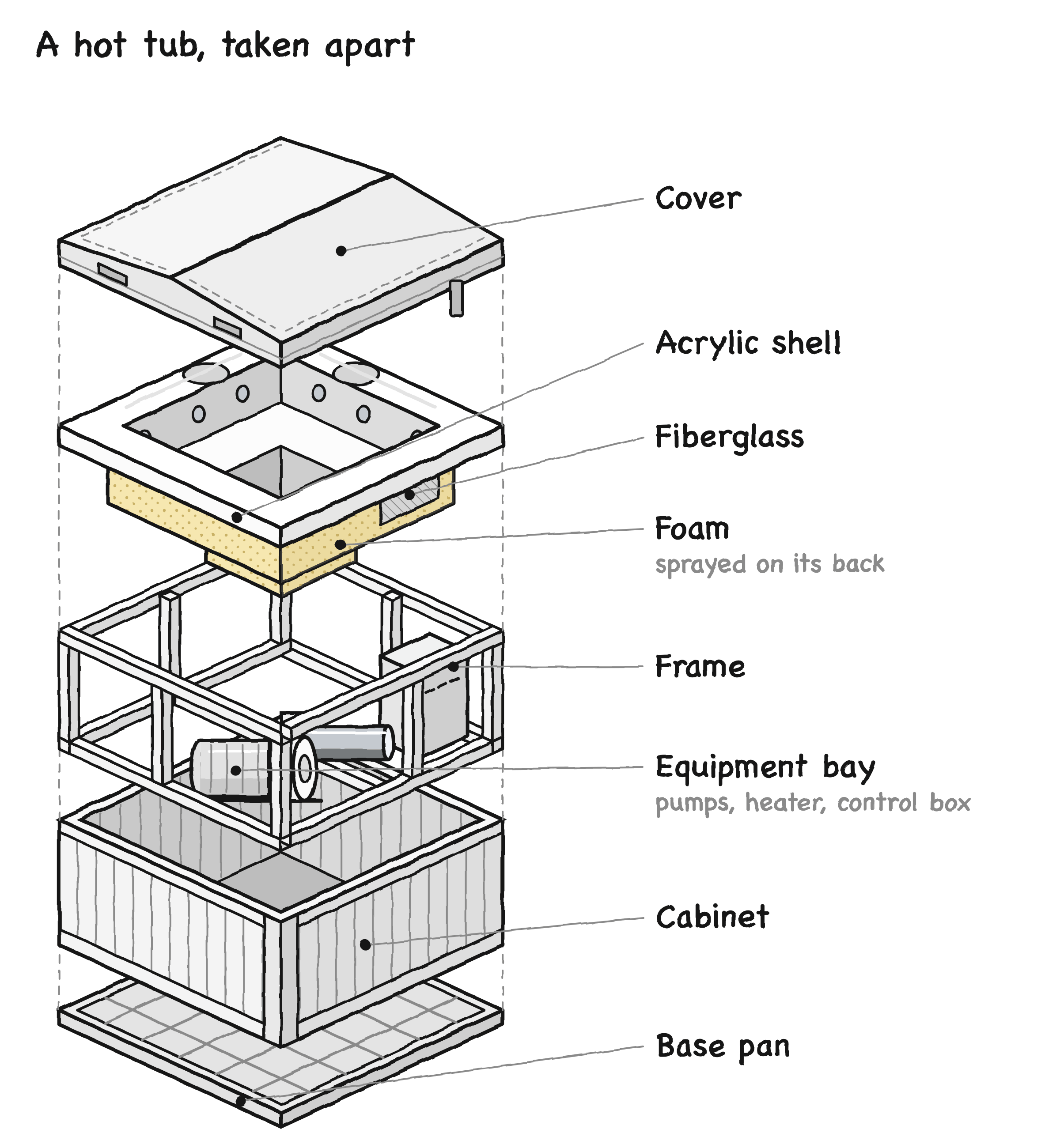
- The hard, glossy plastic sheet that forms the surface of most hot tub shells. It is heated and formed over a mold, then backed with fiberglass or plastic for strength. Types of hot tubs
- Cabinet also skirt
- The outside walls around the shell: wood or synthetic panels that hide the frame, the pipes and the equipment. Types of hot tubs
- Cool-down seat
- A raised seat that sits higher in the water, so you can cool off without getting out. Hot tub sizes
- Cover
- The insulated lid: a tapered foam core in a vinyl or fabric skin. Plan on a new one about every five years, and read the warranty's rules on covers. Hot tub covers
- Equipment bay
- The space behind one cabinet panel that holds the pumps, the heater and the control box. Standard vs proprietary parts
- Fiberglass laminate also fiberglass backing
- Glass fibers and resin built up on the back of the acrylic until the layer carries the load. It is what makes a shell strong. The self-supporting shell
- Filter well also skimmer
- The opening in the shell wall where water is drawn off the surface and the filter cartridges sit. How to clean a hot tub filter
- Footwell
- The deep open floor in the middle of the tub where everyone's feet go.
- Frame
- The structure inside the cabinet. It holds the cabinet panels and, on some tubs, props up the seats and footwell from below. The self-supporting shell
- Full foam also full-foam insulation
- Insulation that fills the whole space between the shell and the cabinet with foam, burying the pipes in it. Hot tub insulation
- Inflatable hot tub
- A vinyl ring you blow up, with a separate pump-and-heater unit. It runs on a small 120V heater, so it heats slowly. Inflatable vs hard shell
- Lounger
- A full-length reclined seat you lie back in with your legs out. It uses room inside the same shell rather than making the tub bigger. Hot tub sizes
- Open seating
- A layout of upright seats all the way around, with no lounger, so more people fit in the same size tub. Hot tub sizes
- Perimeter insulation
- Insulation that lines the cabinet walls and floor and leaves an air space around the plumbing, where waste heat from the pumps collects. Hot tub insulation
- Rotomolded also rotomold, rotational molding
- A one-piece plastic hot tub made by fusing plastic powder into a single wall inside a heated mold. The shell and the outside are the same piece. Types of hot tubs
- Self-supporting shell
- A shell with enough fiberglass built up behind the acrylic to carry the water and the people on its own, with no posts or foam holding it up. The self-supporting shell
- Shell
- The molded tub you sit in. On most hot tubs it is acrylic about an eighth of an inch thick, so its strength comes from what is bonded to its back. The self-supporting shell
- Weir
- The floating flap at the mouth of the skimmer. It lets surface water spill in and keeps what it caught from floating back out. Hot tub filters
Jets, pumps and plumbing
What moves the water and how it gets to you.
- Air control
- A knob that bleeds air into a group of jets for a bubblier, softer stream. Adjustable jets
- Barbed fitting also barb
- A plastic fitting with ridges that grip the inside of a hose. The best builds add glue and a stainless clamp so the hose can't creep off. Clamped plumbing
- Blower
- A small air pump that pushes unheated air through jets or floor holes for bubbles. Adjustable jets
- Brake horsepower also BHP
- A peak power figure a pump motor reaches briefly and can't keep up. Spec sheets often print it; ask for continuous horsepower or amps instead. Jets and pump power
- Circulation pump also circ pump
- A small pump that runs most of the day to push water through the filter and heater, quietly and on little power, so the jet pumps can rest. Circulation pumps
- Continuous horsepower
- The power a pump motor can keep up all the time. It is smaller than the brake figure, and it is the figure to compare between tubs. Jets and pump power
- Daisy chain
- Plumbing where one hose runs from jet to jet. The jets at the end get the least water, like the last sprinkler on a garden hose. Manifold vs daisy chain
- Diverter also diverter valve
- A valve that swings one pump's water between groups of jets or seats. It changes a whole group, not one jet. Adjustable jets
- GPM also gallons per minute
- Gallons per minute: how much water a pump moves. Some makers quote it instead of horsepower, and heater flow checks use it too. Jets and pump power
- Heater
- An electric element in the water line, usually 4 to 5.5 kW on 240V and 1 to 1.5 kW on 120V. More kilowatts heat the water faster. Hot tub heaters
- Jet
- A nozzle in the shell that sprays water, often mixed with air. Rotating, pulsing, directional, neck and foot jets each feel different. Jets and pump power
- Jet body
- The housing set through the shell that the insert sits in. On a well-built tub a gasket and a back nut hold it, so a leaking one is resealed or unscrewed, not cut out. Compression-fitted jets
- Jet insert also jet face
- The part of a jet you see, the nozzle that spins, pulses or points the water. It wears out, so on a well-built tub it twists out by hand. Compression-fitted jets
- Jet pump
- The motor that drives the jets. Pump power behind the seats you use matters more than the number of jets. Jets and pump power
- Manifold
- A fat pipe with a row of outlets near the pump. Each jet gets its own hose from it, so every jet gets its share of water. Manifold vs daisy chain
- Variable-speed pump
- A pump whose motor runs at many speeds, not just high and low. In hot tubs it mostly drives one massage seat. Variable-speed pumps
Water care
Keeping the water clean and balanced.
- Biofilm
- A slime of microorganisms stuck to the pipes and the shell, where sanitizer struggles to reach. Flush the lines before you drain, then scrub every surface. Biofilm and line flushing
- Bromine
- A sanitizer used instead of chlorine. CDC says keep it at 4 to 8 ppm in a hot tub. Chlorine vs bromine
- Calcium hardness
- How much calcium is dissolved in the water. Too much scales the heater and clouds the water; too little is hard on equipment and makes it foam. Calcium hardness
- Chloramines also spent chlorine, combined chlorine
- Chlorine that has already reacted with sweat and oils. It causes the sharp pool smell; a shock burns it off. Hot tub smells
- Drain and refill
- Emptying the tub and filling it with fresh water every few months, to reset what the chemicals can't remove. How to drain and refill
- Filter cartridge also filter
- A pleated cylinder behind the skimmer that strains the water. More square feet of pleats holds more dirt between cleanings. Hot tub filters
- Free chlorine
- The chlorine still able to kill germs. CDC says keep it at 3 ppm or more in a hot tub. Hot tub chlorine levels
- Mineral cartridge
- A cartridge that slowly releases silver, copper or zinc so you can run less chlorine, not none. Refills are a running cost. Mineral systems
- Ozone also ozonator
- A small generator makes ozone gas and draws it into the plumbing, where it breaks down oils and germs, then turns back into oxygen. It cuts chlorine use; it doesn't replace it. Ozone vs UV
- pH
- How acidic the water is. CDC gives 7.0 to 7.8 for hot tubs. Low pH corrodes metal; high pH clouds the water and slows chlorine down. Hot tub pH
- ppm also parts per million
- Parts per million: the unit test kits and manuals use for chlorine, bromine, alkalinity and calcium. Hot tub water chemistry
- Salt system also salt water, chlorine generator
- A cell in the plumbing that makes chlorine from salt dissolved in the water. The cell wears out and has to be replaced. Salt water hot tubs
- Sanitizer
- The chemical that kills germs in the water, chlorine or bromine. Ozone, UV and minerals help it; none of them replaces it. Hot tub water chemistry
- Sequestrant also metal sequestrant
- A product that holds dissolved metals in the water so they don't stain the shell. Metals and stains
- Shock
- A large dose of oxidizer, chlorine or a non-chlorine shock, that burns off spent chlorine and body waste the normal dose can't keep up with. How to shock a hot tub
- Test strip
- A strip with pads that change color in the water. You match them to the chart on the bottle to read chlorine, pH and alkalinity. Test strips vs a test kit
- Total alkalinity also alkalinity
- The water's buffer, the shock absorber that keeps pH from swinging. Too low and pH bounces; too high and pH won't move. Hot tub alkalinity
- UV-C also UV system
- A germ-killing lamp sealed in a clear sleeve inside the plumbing. It treats only the water passing it, so you still need chlorine. Ozone vs UV
Power and the backyard
What the spot and the circuit need.
- 240V, 50A circuit also 240V, 50 amp, 220V
- What most hot tubs need: their own 240-volt circuit on a 50-amp breaker, wired by a licensed electrician. Some need 40 or 60 amps. Hot tub electrical requirements
- AWG also wire gauge
- American Wire Gauge, the wire size. A smaller number is a thicker wire: 6 AWG is thicker than 8. The electrician sizes it for the breaker and the run. Hot tub electrical requirements
- Breaker
- The switch in your electrical panel that protects a circuit. The tub's spec sheet sets its size in amps; most need 50. Hot tub electrical requirements
- Concrete pad also slab
- A flat slab of reinforced concrete, at least 4 inches thick. It is the base makers' instructions recommend. What to put a hot tub on
- Disconnect
- A shutoff box near the tub, within sight of it but at least 5 feet away, so the power can be cut by someone who isn't in the water. Hot tub electrical requirements
- GFCI also ground-fault circuit interrupter
- A safety switch that cuts the power in a fraction of a second if current leaks to ground, for example through water and a person. Hot tubs must have one. Hot tub electrical requirements
- kW also kilowatt
- Kilowatts, a thousand watts. Heaters are rated in kW; your electric bill counts kilowatt-hours (kWh). Hot tub heaters
- Live load also lb per square foot, psf
- How much weight a deck or floor is built to carry per square foot. The building code designs an ordinary deck for 40; a full hot tub puts down about twice that. What to put a hot tub on
- Plug-and-play (120V) also 120V, plug-in hot tub
- A tub that runs on a dedicated household outlet instead of a 240-volt line. It has one jet pump and a small heater, so it heats slowly and can't run the heater and the jets at full at the same time. Plug-and-play hot tubs
- Standby power also standby watts
- The power a covered, idle tub draws to stay hot, measured in California's test. It is what sets the monthly bill before anyone gets in. Hot tub running cost
Controls and error codes
The panel you press and what it tells you.
- Air lock
- Air trapped in a pump after a refill that stops it moving water. It often shows up as a flow code. FLO and flow codes
- Balboa
- A company that makes hot tub controls and parts sold to many brands. Its error codes are one of the two common lists. Balboa error codes
- Control box also spa pack, control pack
- The box in the equipment bay with the circuit board that runs the pumps and the heater. Standard vs proprietary parts
- Error code
- A message on the topside panel saying why the tub stopped heating or shut down. Most point at water flow: the filter, the water level or a valve. Hot tub error codes
- Filter cycle
- The hours each day the tub runs a pump to push water through the filter, set at the topside panel. Maintenance schedule
- Flow switch also pressure switch
- A sensor that checks water is moving past the heater before the heater turns on. Never bypass it. FLO and flow codes
- Gecko
- The other big maker of hot tub controls. Its codes differ from Balboa's, even when the letters are the same. Gecko error codes
- High limit
- A safety cutoff that shuts the heater off when the water or the heater gets too hot. A high-limit code means stay out until the water cools. What HL means
- Topside panel also topside, control panel, keypad
- The control panel on the rim of the tub: the buttons and display you use to set the temperature and run the jets. Hot tub error codes
Buying
Words you will hear in the showroom.
- Maker's list price (MSRP) also MSRP, list price
- The price a maker publishes for a model. A dealer's quote can differ, and installing the tub is a separate cost. What a hot tub costs
- Service network
- Who will come to your house to fix the tub: the dealer's own technicians, a contracted repair company, or an independent. Service network
- Shell warranty also shell structure, shell surface
- A warranty is split into parts, each with its own clock. Shell structure covers the shell leaking; shell surface covers the acrylic cracking, blistering or peeling; equipment covers pumps, heater and controls. Hot tub warranties compared
- Standard parts also OEM parts
- Parts from big suppliers like Balboa, Gecko and Waterway that many stores sell. Proprietary parts come from one maker, at its price, for as long as it makes them. Standard vs proprietary parts
- Wet test
- Sitting in a filled display tub at the dealer before you buy. Optional. What to check in person
Ten questions, three tubs that fit you.
Take the 2-minute quizWhat a good deal looks like, then one dealer near you.
Get the price range