Check 1 of 8
Self-supporting shell
A shell strong enough to hold the water and the people by itself. Thinner shells lean on foam and wood, flex, and crack over time.
What it is
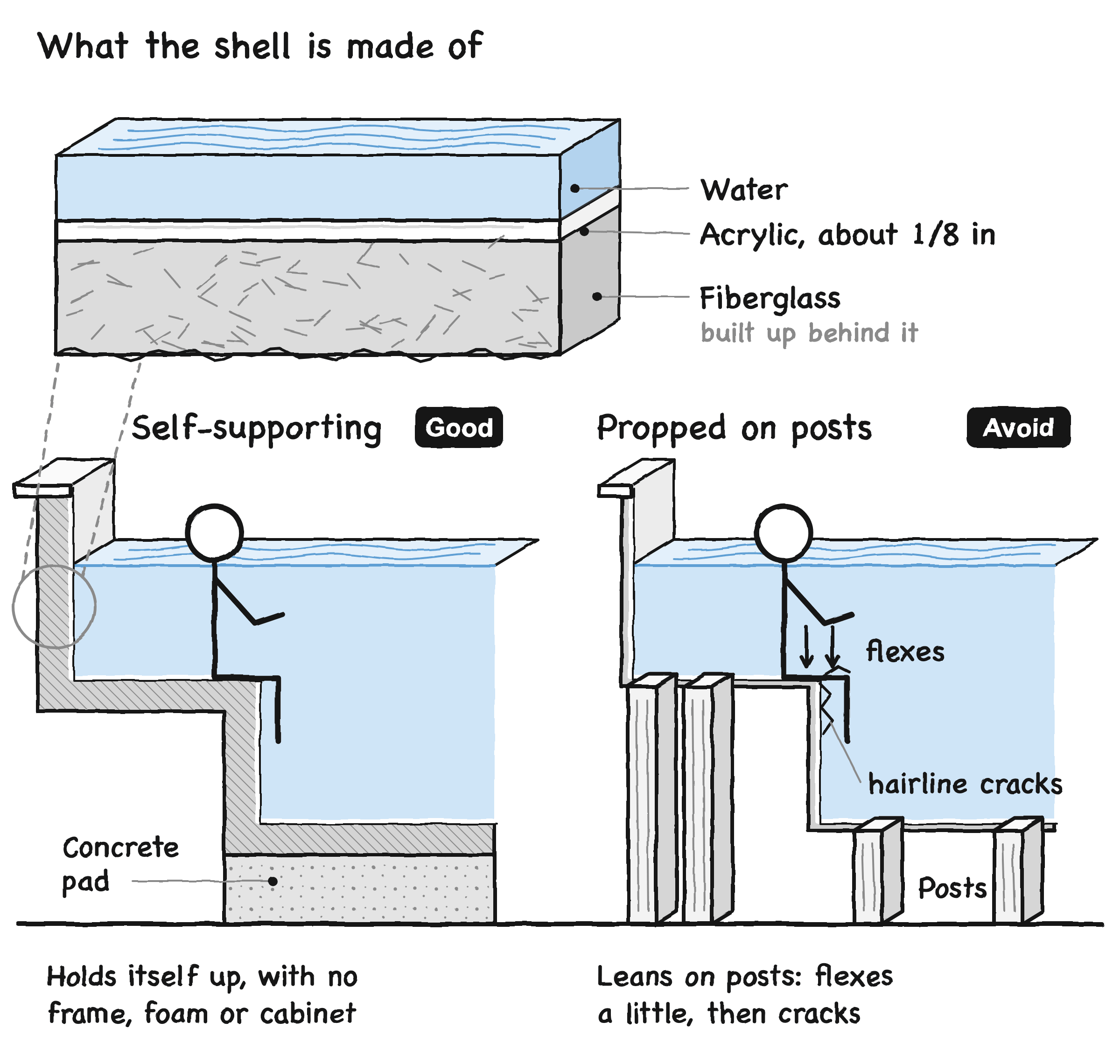
The shell is the molded acrylic tub you sit in. The acrylic itself is only about an eighth of an inch thick, so its strength comes from whatever is bonded to the back of it.
A self-supporting shell has enough fiberglass built up behind the acrylic to carry the whole load on its own. You could take away the wood frame, the insulation and the cabinet, set the bare shell on a concrete pad, fill it with water and people, and it would hold with no problem. Arctic, for example, says it sprays about an inch of fiberglass onto the back of its shells, which adds roughly 700 pounds.
Why it matters
A shell that isn't self-supporting is a lot thinner and has little or no fiberglass behind it. Some makers use a thin plastic backing instead. To keep its shape, the shell leans on what's around it: foam sprayed against it, posts under the seats, or a frame.
The problem is that it still moves. Every time someone sits down, and every time the water heats up and cools off, the shell flexes a little. Sometimes you can feel it as a seat that gives under you. That movement is what does the damage. Over the years it opens hairline cracks and splits at the seat edges and around the jets. They might not leak right away, but that little bit of movement keeps adding up, and eventually you have a leaking shell.
That's the expensive kind of problem. A pump or a heater is a part you swap. A shell isn't: a new one costs close to a new tub.
How makers do it
Thick fiberglass laminate behind the acrylic
The good wayGlass and resin are built up on the acrylic's back until the laminate carries the load. PDC says its shells stand without framed support.
One-piece rotomolded plastic
AcceptablePlastic powder fuses into a single wall inside a heated mold. Caldera says its Fantasy shell needs no extra supports or fiberglass.
Thin backing stiffened by bonded foam
AvoidThe acrylic gets a thin plastic backing and sprayed foam bonds to it. A 2018 Sundance patent filing describes an eighth inch of ABS plastic.
Shell propped on posts or frame
AvoidSupports under the seats and footwell carry the water. Bullfrog says its molded EnduraFrame, with extra supports in high-use areas, bears the weight.
In the showroom
- Sit in an empty display tub and press hard on each seat. It should feel solid, like a floor.
- Read the spec sheet for how the shell is backed: fiberglass, ABS, or not stated.
- Read the warranty card: is the shell structure covered against cracking, or only against leaking?
Ask the dealer
- Does this shell hold its shape on its own, or do foam and a frame hold it up?
- What's behind the acrylic: hand-rolled fiberglass, or a plastic backing sheet?
- If this shell cracks in year eight, who pays for removal and shipping?
The details
Where the evidence gets complicated, how each brand does it, and the sources.
Where it gets complicated
Props aren't always a cover-up: Beachcomber says it hand-rolls 7 to 10 coats of fiberglass and still puts a beam under every seat. Fine crazing is usually cosmetic; Dimension One's warranty calls it normal wear. And pumps and heaters usually fail years before a decent shell.
Where the brands stand
13 of 15 brands
13 of 15 brands publish enough to tell. Where a brand doesn't, ask the dealer.
Sources
18
- Hot Tub Insider - Shell Design & ConstructionShells start as roughly 1/8-inch cast acrylic, vacuum-formed and then backed with resin and chopped fiberglass; acrylic/ABS sheet is formed in one pass.
- Arctic Spas - How a hot tub is madeArctic sprays about an inch of fiberglass onto the acrylic, adding about 700 pounds to the tub.
- AquaBond Adhesives - Epoxy for hot tub crack repairCracks near seats, steps and jets are flex points that often signal a support problem underneath.
- Multi-Tech Products - How to install support beams under a fiberglass pool, spa or hot tub shellRepair-side symptoms of an under-supported shell: seats dropping under weight, a sagging lip, cracks in upper corners.
- HomeAdvisor - Hot tub repair cost dataMajor shell cracks run into the thousands, and a full shell replacement approaches the cost of a new tub.
- Cal Spas - 2025 Patio and Patio Plus limited warrantyA shell Cal Spas deems non-repairable is replaced for 1% of current retail per full month owned after the first six months, plus removal, freight and installation.
- PDC Spas - ConstructionLucite acrylic backed with multiple layers of hand-rolled fiberglass; PDC says its shells can stand with no framed support.
- PoolAndSpaRatings - ShellHand-rolling each glass layer prevents air voids; ABS-backed shells are structurally weaker and rely on foam.
- Caldera Spas - Fantasy AspireCaldera's rotomolded one-piece shell needs no extra supports or fiberglass backing and keeps costs below acrylic tubs.
- Hot Spring Spas - What are hot tub shells made of?Rotomolded shells are lighter, with a matte finish and weaker heat retention than acrylic.
- US 2018/0243165 A1 - Spa tub and cabinet construction system (Sundance Spas, Inc.)Describes acrylic backed with about 1/8 inch of ABS, sprayed foam on the shell bottom and rim, and a shell supported on a base pan and ABS frame.
- Jacuzzi - What is the most durable material for a hot tub?A maker describing full foam around the shell as adding structural strength, not just insulation.
- Bullfrog Spas - ConstructionThe molded EnduraFrame, with extra supports in high-usage areas, supports the weight of the water; no claim of a self-supporting shell.
- Dimension One Spas - 2025 Bay and Reflections limited warrantyThe factory-installed wood frame sits in the two-year coverage bucket; scratches and crazing are treated as normal wear.
- Bullfrog Spas - WarrantyAn example of the leak-versus-crack split: 10 years on the shell structure worded as will not leak, 7 years on the surface against cracking and crazing.
- Beachcomber Hot Tubs - Why quality7-10 coats of fiberglass hand-rolled onto the acrylic, plus a vertical beam under every seat.
- whatsthebest-hottub.com forum - repairing crazing / spider crackingOwner and technician consensus that surface crazing is usually cosmetic, often from sun and chemicals.
- Epic Hot Tubs - How long does a hot tub last?Pumps, heaters and plumbing typically fail in years 5-10, while the shell and structure last far longer.
Related:Types of hot tubs
Ten questions, three tubs that fit you.
Take the 2-minute quizWhat a good deal looks like, then one dealer near you.
Get the price range