Features, rated
Hot tub features: what's worth paying for
Short answer
We rate 18 hot tub features. 4 are worth paying for (pump horsepower, insulation, covers and filters), 6 are nice to have, 6 depend on how you'll use the tub, and we'd skip 2: audio and water features.
Worth paying forNice to haveDepends on youSkip it
Jets and pumps
Pump horsepower
Spec-sheet horsepower, often brake horsepower: a peak the motor can't sustain. Marquis quotes gallons per minute instead.
Ignore the big horsepower number; ask for continuous HP or amps, then feel the jets in your seat with the back of your hand on a running display.
Jet count
The number of nozzles in the shell, and their styles: rotating, pulsing, directional, neck and foot jets.
Pay for pump power behind the seats you'll use, not for the jet count.
Keeping the water clean
UV-C lights
A germ-killing lamp sealed inside the plumbing, like the ClearRay that comes standard on Jacuzzi's J-200 tubs.
Take UV if it's standard, but don't pay extra for it.
Ozone
A generator that makes ozone gas and draws it into the plumbing. Marquis and PDC fit one to every tub.
Count ozone as a wear part, and don't pay much extra for it.
Salt systems
A cell that makes chlorine from salt dissolved in the water. Hot Spring, Caldera, Master Spas and Cal Spas sell factory versions.
Only buy salt as a factory system the tub's maker warranties, and budget for cells.
Mineral cartridges
Cartridges that slowly release silver, copper or zinc. Master Spas' EcoPur uses copper and zinc; Dimension One's Vision uses silver.
Minerals let you run less chlorine, not none; favor silver with an EPA registration.
Filters
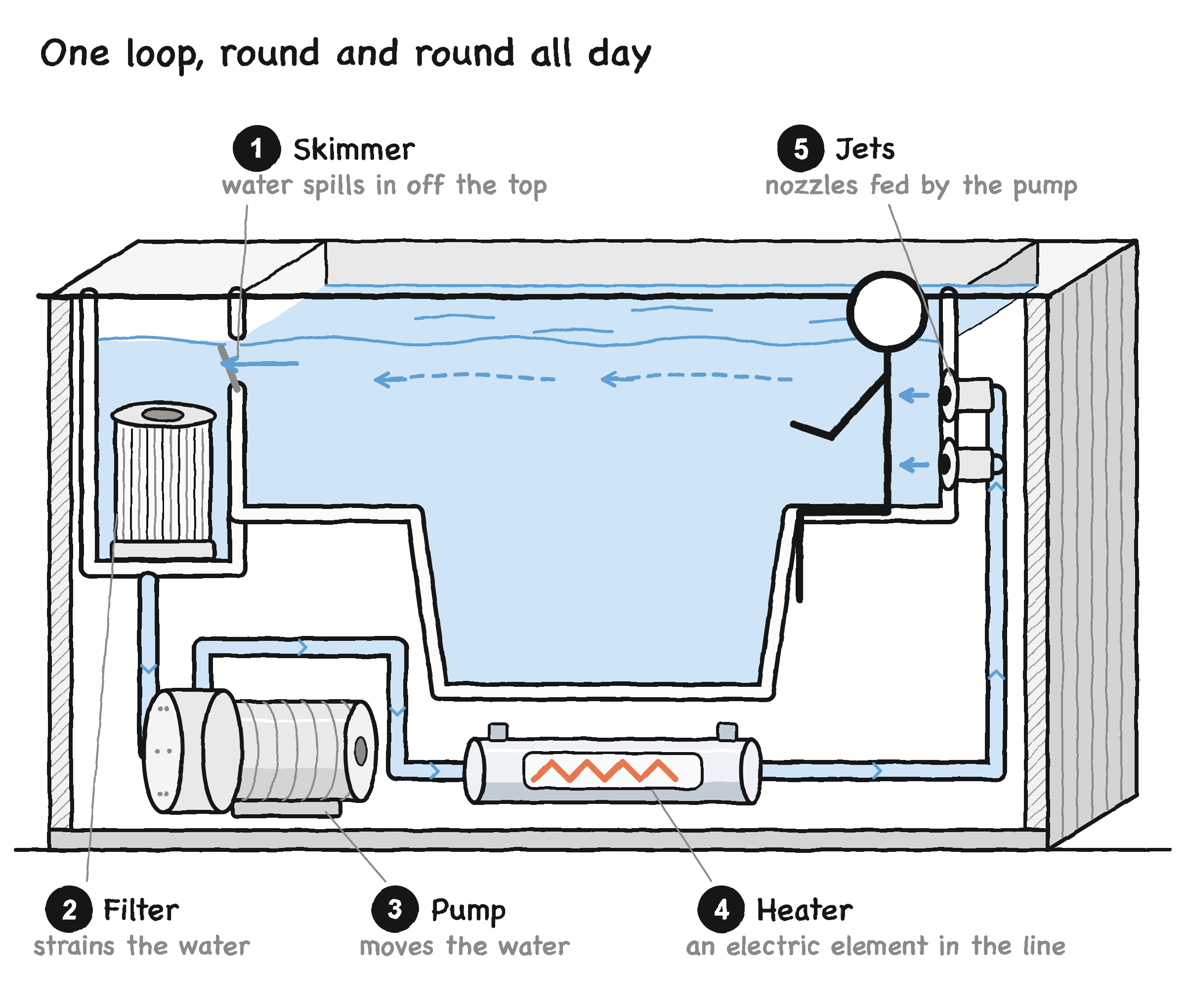
Pleated cartridges behind the skimmer that strain the water. Brands differ in filter area and add-ons like fine inner cores.
Look for generous filter area; it's a cheap route to clear water.
Keeping it warm
Circulation pumps
A small pump that runs most or all of the day to push water through the filter and heater.
Prefer a circulation pump for quiet, low-power filtering.
Insulation
What fills or lines the cabinet: full foam packs the cavity, while perimeter designs line the walls and trap air.
Compare what tubs cost to keep hot, not insulation names: same-size tubs can differ by $20 a month or more.
Covers
The insulated lid: a tapered foam core in a vinyl or fabric skin. Strong and Tuff Spas sell hard covers.
Plan on a new cover about every five years, and check the cover rules before you buy.
Heaters
An electric element in the water line: usually 4 to 5.5 kW on 240V, 1 to 1.5 on 120V.
Ask for the heater's kilowatts and ignore efficiency claims; every element is about 98% efficient.
Variable-speed pumps
Pumps whose electronic motors run at many speeds, not just high and low, like Cal Spas' Throttle Seat pump.
Don't pay extra for the variable-speed label.
How it's built
Luxury vs budget
What separates a cheap tub from a premium one: shell, frame, insulation, pumps and warranty, not the extras on top.
Spend on build quality and warranty, not extras like lights and audio.
Power and apps
120V plug-in tubs
Tubs that plug into a dedicated household outlet instead of a 240-volt line. Jacuzzi's J-215 can switch to 240V later. A 15- or 20-amp circuit can't run a big heater and jets at once, so the heater is small and often pauses for the jets.
Our take: Fine for mild climates and short soaks; buy one that converts to 240 volts later. Nordic's 1 kW heater warms 1 to 4°F an hour, and Dream Maker's shuts off whenever the jets run, so the water cools as you soak.
What to ask the dealer
- Can this model convert to 240 volts later, and what does that involve?
- Does the heater shut off while the jets run?
- What circuit and outlet does it need, and how close to the tub?
Wi-Fi apps
A module and phone app for changing settings and getting fault alerts from anywhere, like Balboa's ControlMySpa.
Get it for a cabin or a cold climate, where a fault alert can save the tub.
Extras
Audio
Built-in Bluetooth speakers and often a subwoofer, set into the cabinet or shell.
Skip built-in audio; it carries one of the shortest warranties and costs hundreds to fix.
Lighting
LED lighting, from one footwell light on Dimension One's @home line to 91 points of light on PDC's Spectrum.
One underwater light covers night soaks; pay for light shows only if you'll use them.
Water features
Waterfalls and fountains, like the three lit arcs on Hot Spring's Highlife tubs.
Don't pick a tub for its waterfall; it's decoration that costs heat and adds parts.
Features are half the decision
A feature list says what a tub has, not how it is built. Check the shell, plumbing and parts with the 8 hot tub build checks, then ask a dealer to price only the features you will use.
Common questions
Which hot tub features are worth paying for?
Pump horsepower, insulation, covers and filters. They decide how the tub feels, how clean the water stays and what it costs to run.
Which hot tub features can you skip?
Audio and water features. Both add price and parts without changing how the tub soaks or lasts, and both carry thin warranty coverage.
Is a salt water hot tub worth it?
Only buy salt as a factory system the tub's maker warranties, and budget for cells. Hot Spring's cartridge costs $129.99 and lasts about four months; Master Spas' Smart Cell is about $350 a year with a 30-day warranty.
Ten questions, three tubs that fit you.
Take the 2-minute quizWhat a good deal looks like, then one dealer near you.
Get the price range