Our verdict: Depends on you
Salt water hot tubs: how the systems work
Short answer
Get salt if you would rather pay more up front than dose chlorine by hand, and pick a system that tests the water and sets its own output. Of the 109 hot tubs we track that take a factory salt system, 23 do that (Master Spas, Master Clear); the other 86 run at a level you set.
Depends on you
Only buy salt as a factory system the tub's maker warranties, and budget for cells. Hot Spring's cartridge costs $129.99 and lasts about four months; Master Spas' Smart Cell is about $350 a year with a 30-day warranty.
Is a salt water hot tub worth it?
It is if your time is worth more to you than the extra cost. A salt system doesn't make better water than chlorine you add yourself, because it is chlorine. What changes is who does the work. The cell makes a little chlorine every day, so the water stays sanitized between the times you check it, and the weekly job is mostly testing and correcting pH.
Buy it from the tub's own maker, and ask how the system decides how much chlorine to make. Some read the water and run only when the chlorine is low. Others run a set number of hours a day whether anyone used the tub or not, and you turn the dial.
How does a salt water hot tub make chlorine?
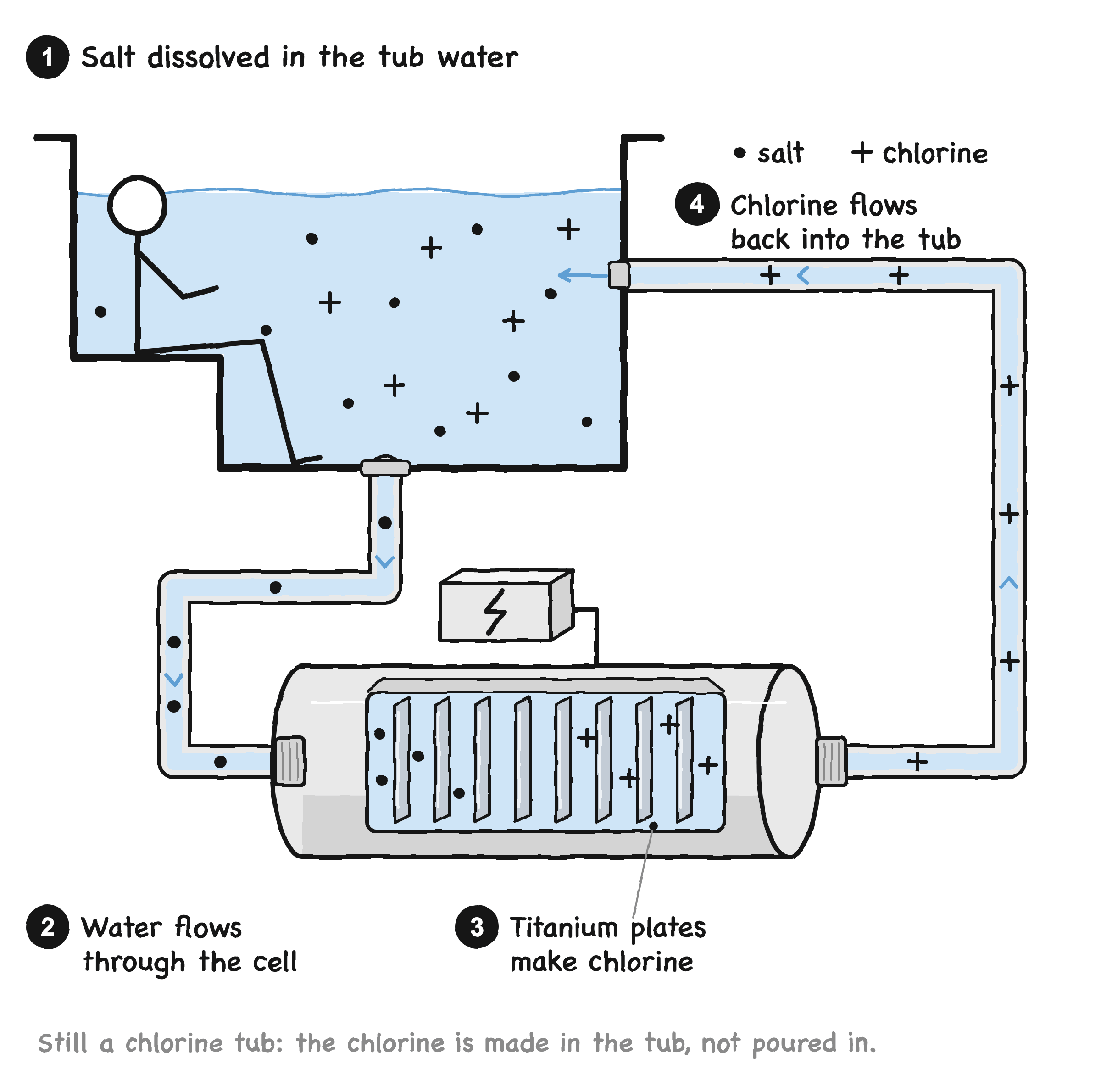
By electrolysis: a low-voltage current through salty water turns chloride into chlorine. You dissolve salt, sodium chloride, to about 1,750 parts per million (ppm) for Hot Spring's system, and the water flows past a cell of titanium plates on a 12-volt DC supply.
At the positive plate, the anode, chloride ions give up electrons and pair up as chlorine gas. At the negative plate, the cathode, water takes those electrons and splits into hydrogen gas and hydroxide, a base. The sodium stays dissolved and never turns into metal.
The chlorine gas dissolves as it forms and reacts with water to make hypochlorous acid, the chemical that kills germs. It is a weak acid: part of it splits into hypochlorite, a far weaker germ killer, and the split depends on pH. At about pH 7.5 it is half and half, so pH matters as much as the chlorine reading. In effect the cell makes liquid chlorine inside the tub.
How much it makes depends on how long the plates run. Hot Spring rates its cartridge at up to 17 grams of chlorine a day. In a 400-gallon tub that is about 11 ppm a day, several times the target, so something has to hold the output back. That something is what separates the systems below. The hydrogen bubbles away, which is why Hot Spring warns against running the cell with no water flowing.
Where does the chlorine go, and why doesn't the salt run out?
Chlorine gets used up killing germs and breaking down sweat and oils, and spent hypochlorous acid ends up as chloride again, plus a little acid. So the salt goes around in a loop: chloride to chlorine in the cell, chlorine back to chloride in the water. Some ends up as combined, spent chlorine (chloramines), which is what smells strongly of chlorine. That is why Master Spas still calls for a weekly oxidizer shock with its salt system.
Salt leaves only with water. Hot Spring says making chlorine doesn't reduce the salt; it drops only when you add fresh water after splash-out or a partial drain, and adding chemicals can push it up. You add salt at each refill and a little after topping off.
Why does pH go up in a salt water hot tub?
Because the cell makes a base at its plates, and its bubbles drive carbon dioxide out of the water. Right at the cathode, the hydroxide makes the water very alkaline, and that is where scale forms. That is why Hot Spring wants calcium hardness of just 25 to 75 ppm with its salt system, and Master Spas has owners check the cell monthly and soak off scale in vinegar.
Across the whole tub, the base nearly cancels out: the acid released when the chlorine is used up matches it, as with liquid chlorine. What keeps pH climbing is carbon dioxide leaving the water. The cell's hydrogen bubbles stir it out, and losing carbon dioxide raises pH.
The makers agree on what you'll see. Hot Spring and Master Spas both say pH may rise in the first weeks after a fill, and the FreshWater monitor's manual says pH drifts up and needs regular correcting. Master Clear's schedule puts the pH check once a week. See hot tub pH for how to bring it down.
Why does steady chlorine matter in a hot tub?
Because chlorine doesn't last long in a small tub of hot water, and the water is protected only while some is left. Master Spas' manual says chemicals run out faster in a spa than a pool and bacteria grow faster. Hot Spring's says dichlor lasts much longer in 80°F water than at 101 to 104°F.
The target is a few ppm, held all the time. CDC says hot tub chlorine should be at least 3 ppm. Hot Spring's manuals allow 1 to 5 ppm with a 3 ppm target; Master Spas and Cal Spas ask for 2 to 4 ppm with their salt systems. Hot Spring and Master Spas both say to stay out above 5 ppm. More on the numbers is on hot tub chlorine levels.
Holding that band by hand means small doses often, which is what Hot Spring tells owners to do. Most people dose once a week instead. One dose can't cover seven days: to last, it has to start above the 5 ppm line, and by the weekend it has run low. Hot Spring warns that low chlorine lets bacteria grow fast in warm water.
The swings do little to pH on their own. Hot Spring calls dichlor, the granular chlorine it recommends, nearly pH neutral. Liquid chlorine raises pH going in and nets out close to neutral. Trichlor tablets push pH down, and Hot Spring and Master Spas bar them.
The real cost of weekly dichlor is what it leaves behind. It is 57% cyanuric acid by weight, which never gets used up, so it builds with every dose. CDC researchers found it slows how fast chlorine kills. Master Spas' salt warranty even excludes damage from repeated cyanuric-acid products. A salt cell makes plain chlorine, a little every day. That is the case for salt.
Is salt water better for your skin?
There's no good evidence that it is. The salt is weak: Hot Spring's 1,750 ppm is about a twentieth of seawater, which averages 35 parts salt per 1,000. The water is sanitized by the same chlorine as any other tub.
Makers say otherwise in their marketing. Hot Spring's manual calls salt water softer, and its web page promises no itchy, dry skin or eyes. We found no controlled study behind claims like these. The closest is a 2025 study built on 100 interviews in the US pool and spa trade, where 30% of respondents mentioned less eye irritation or a smoother skin feel with salt. Those are opinions, not measurements.
Which salt systems test the water and adjust themselves?
One. Of the 15 hot tub brands we track, four sell a factory salt system on US models, using three systems, and one passes both parts of the test: it reads the water and decides on its own how much chlorine to make, and it reads the salt level. That is Master Spas' Master Clear.
| Master SpasMaster Clear | Tests and adjustsRuns only when it reads low; you tune a 1 to 10 level | Yes, between cycles | Yes: low, balanced or high |
|---|---|---|---|
| Cal SpasCal Salt Filtration Plus | Set by handYou set the hours a day on a timer | No | Yes: low or high light |
| Caldera SpasFreshWater Salt System | Set by handYou set 0 to 10, the hours it runs a day | IQ monitor included on Utopia, optional on Paradise | A status reading; IQ measures it |
| Hot SpringFreshWater Salt System | Set by handYou set 0 to 10, the hours it runs a day | Only with the optional IQ monitor, hourly | A status reading; IQ measures it |
Master Clear's Smart Cell senses the sanitizer between cycles, runs only when it reads low, holds off when chlorine is already high, and reports salt as low, balanced or high. You still tune it with a level from 1 to 10 and test weekly. Master Spas doesn't say what the sensor measures or publish a salt target; its maximum-salt table works out to about 1,200 ppm.
Hot Spring and Caldera share the FreshWater Salt System. You set an output from 0 to 10, the hours the cartridge runs each day, and the manual says plainly that it is not an automatic water care system. The optional FreshWater IQ sensor, included on Caldera's Utopia, tests chlorine, pH and salt every hour and tells you which way to move the dial, but you make the change.
Cal Spas' Cal Salt runs on a timer you set in hours per day, found by testing chlorine daily at first. A light warns of low or high salt; nothing reads the chlorine.
The other 11 brands we track sell no salt system on US models. Nordic and Marquis (on its Celebrity line) say adding one voids the warranty, Jacuzzi said so in a 2012 FAQ and its current warranties exclude damage from parts it didn't make, and even Master Spas warns that other makers' salt systems cause wear it won't cover. So don't fit an aftermarket cell; buy the one the tub's maker sells.
What does a salt water hot tub cost to run?
Mostly the cell, at about $350 to $390 a year. Hot Spring's store lists the FreshWater cartridge at $129.99 for about four months. Master Clear's Smart Cell sells for $350 to $379.99 at online parts stores, lasts about a year and carries a 30-day warranty. The 2025 interview study put spa salt systems at $400 to $600 a year to run and $2,000 to $4,200 up front.
What you pay up front depends on the tub. Hot Spring's Highlife and Caldera's Utopia include the system. For salt-ready Limelight and Paradise tubs, an authorized FreshWater dealer lists the start-up kit, with controller, cartridge and salt, at $399.99. We found no published price for the Master Spas or Cal Spas option, so ask for it as its own line on the quote.
The upkeep changes rather than disappears. Hot Spring advises against ozone with its salt system, and Master Clear wants mineral filters swapped for plain ones. The water lasts longer: up to a year between drains on Hot Spring's salt system against three to four months without it. Master Clear keeps Master Spas' usual 180 days.
What to ask the dealer
- Did this tub's maker build the salt system, and does the warranty cover it?
- What does a new cell cost, and how often will I buy one?
- Will my hard water cause problems for it?
The details
Which brands offer it, the research behind the verdict, and the sources.
Which brands offer it
15 brands
| Master Spas | OptionalMaster Clear Salt System | Tests and adjusts | 23 |
|---|---|---|---|
| Cal Spas | OptionalCal Salt Filtration Plus | Set by hand | 49 |
| Caldera Spas | Some modelsFreshWater Salt System | Set by hand | 18 |
| Hot Spring | Some modelsFreshWater Salt System | Set by hand | 19 |
| American Whirlpool | Not listed | No salt system | 0 |
| Artesian Spas | Not listed | No salt system | 0 |
| Bullfrog Spas | Not listed | No salt systemSays it doesn't offer one | 0 |
| Dimension One Spas | Not listed | No salt system | 0 |
| Jacuzzi | Not listed | No salt systemA 2012 FAQ says one voids the warranty | 0 |
| Marquis | Not listed | No salt systemVoids the Celebrity warranty | 0 |
| Nordic Hot Tubs | Not listed | No salt systemAdding one voids the warranty | 0 |
| PDC Spas | Not listed | No salt system | 0 |
| Sundance Spas | Not listed | No salt system | 0 |
| Vita Spa | Not listed | No salt system | 0 |
| Wellis | Not listed | No salt systemSmartSalt is only on Wellis' global site | 0 |
What the research says
9 findings
- Trade Salt systems are chlorine generators: electrolysis makes chlorine plus sodium hydroxide, which steadily pushes pH up and encourages scale on the cell.
- Maker Hot Spring specifies about 1,750 ppm salt and a titanium cartridge replaced every four months, with the chlorine output level set on the control panel. Owners still test and balance pH, alkalinity and hardness, and Hot Spring says water can last about a year between drains depending on use.
- Maker Hot Spring's store listed the FreshWater Salt cartridge at $129.99, rated for about 4 months.
- Study A 2025 peer-reviewed review, mostly about pools, found that 44% of the professionals it interviewed warned about corrosion and damage to other equipment from salt systems. That's what they believe, not a corrosion test on hot tubs. It puts pool cell life at 2 to 5 years and reports that salt pools average 15% higher total disinfection byproducts than traditional chlorine pools.
- Maker Jacuzzi, which sells no salt system, said in a 2012 ClearRay FAQ that salt chlorine generators are not recommended in its hot tubs because of corrosion risk and that using one voids the warranty.
- Maker Marquis, which doesn't sell salt, argues that salt can corrode heaters and metal trim, that over-chlorination under the cover can damage pillows and covers, and that such damage may be treated as chemical abuse under warranty.
- Trade EPA classes electrolytic halogen generators as pest-control devices, not registered sanitizers.
- Maker Master Spas' 2026 Master Clear manual says to replace the Smart Cell about yearly and warrants it 30 days.
- Trade An independent seller lists the Master Clear Smart Cell at about $350.
Common questions
Is a salt water hot tub worth it?
Yes, if you would rather pay more up front than dose chlorine by hand. The cell makes chlorine every day, so you mostly test and adjust pH. Budget for cells: Hot Spring's cartridge is $129.99 about every four months, and Master Clear's cell sells for $350 to $379.99 and lasts about a year.
Does a salt water hot tub need chlorine?
It is a chlorine hot tub. The cell turns dissolved salt into chlorine. Hot Spring and Cal Spas still have you add chlorine at start-up, and every maker says to keep testing the water.
Is a salt water hot tub better for your skin?
There's no good evidence that it is. The salt is about a twentieth as strong as seawater and the water is sanitized by chlorine. The only support we found is interview responses, not measurements.
Why does pH keep rising in a salt water hot tub?
The cell makes hydroxide at its plates, and its hydrogen bubbles drive carbon dioxide out of the water, which raises pH. Hot Spring and Master Spas both say pH may rise after a fill; test and add pH down as needed.
Which hot tub salt systems adjust chlorine automatically?
Master Spas' Master Clear senses the sanitizer and runs only when it reads low. Hot Spring's and Caldera's FreshWater system runs at an output you set, with an optional monitor that tells you when to change it. Cal Spas' Cal Salt runs on a timer.
How much salt goes in a salt water hot tub?
Hot Spring targets 1,750 ppm. Cal Spas' manual gives 1,500 to 1,700 ppm in one place and 1,900 to 2,000 in another. Master Spas doesn't publish a ppm figure; its controller shows low, balanced or high.
Sources
22
- Master Spas: Master Clear Salt System owner's manual, 2026how the Smart Cell senses and runs, salt readout, water targets, cell life and warranty
- Master Spas: Master Clear Salt Systemwhich series offer it
- Hot Spring: FreshWater Salt System owner's manual0 to 10 output level, salt 1,750 ppm, 17 g a day, salt not used up
- Hot Spring: FreshWater Salt System owner's manual, earlier editionoutput runs whether or not the tub is used; cyanuric acid lock
- FreshWater Smart Monitoring System owner's manualhourly chlorine, pH and salt readings; the owner adjusts output
- Hot Spring: FreshWater IQavailability by collection
- Caldera: FreshWater IQavailability by series
- Hot Spring: Highlife owner's manual, 2026chlorine targets, dichlor, warm vs hot water, drain intervals
- Cal Spas: Cal Salt Filtration owner's manual, 2024timer control, salt light, 2 to 4 ppm
- LibreTexts: electrolysis of brineanode and cathode reactions
- EPA: Alternative Disinfectants and Oxidants Guidance Manual, 1999hypochlorous acid, pKa 7.5, hypochlorite and pH
- Orenda: does chlorine affect pH?each chlorine's pH effect; carbon dioxide loss
- CDC: staying healthy in hot tubschlorine at least 3 ppm
- CDC researchers on cyanuric acid, Environmental Science & Technology, 2015cyanuric acid slows chlorine
- Montana DPHHS: cyanuric acid and stabilized chlorinedichlor is 57% cyanuric acid; it accumulates
- ACS ES&T Water: disinfection systems for pools and spas, 2025interview findings and cost ranges
- DOSITS (University of Rhode Island): salinityseawater averages 35 parts per thousand
- Jacuzzi: ClearRay FAQ (2012)salt generator voids the warranty
- Jacuzzi: 2026 J4 warrantyexcludes damage from non-Jacuzzi aftermarket parts; no salt clause
- Marquis: Celebrity warrantysalt generators void the warranty
- Nordic Hot Tubs: owner's manualsalt systems void the warranty
- Bullfrog Spas: water careno salt systems offered
Ten questions, three tubs that fit you.
Take the 2-minute quizWhat a good deal looks like, then one dealer near you.
Get the price range