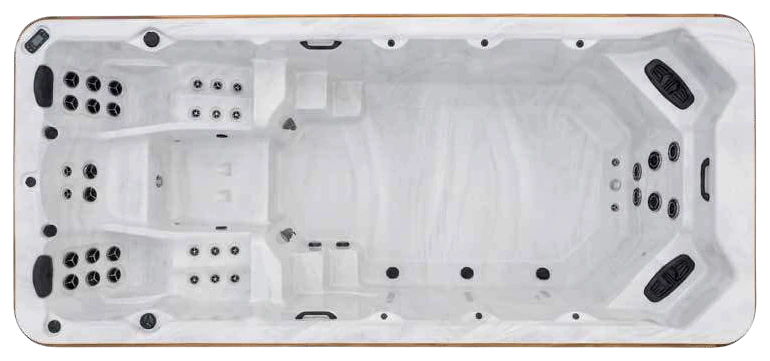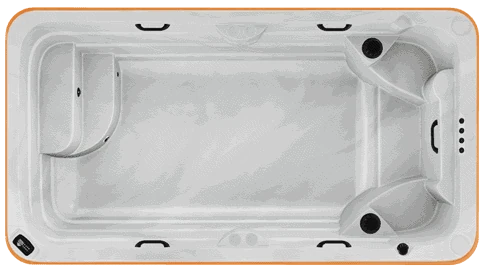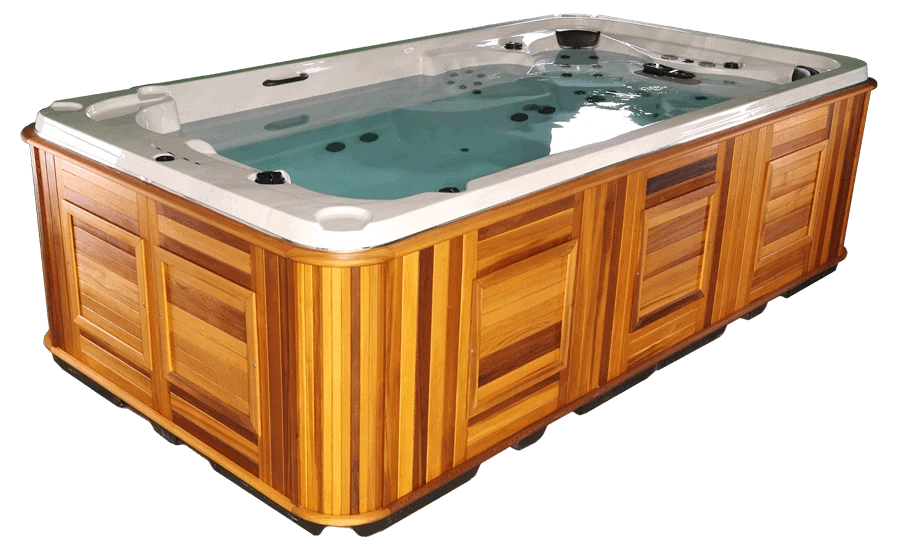
Columbia
14′ 4″ · jet current
8′ 2″ of open water
Price on request
Swim spa brand
The hot tub built for Canadian winters: it reuses its own pump heat, sits on a floor that can't rot, and runs its own salt-water chemistry.
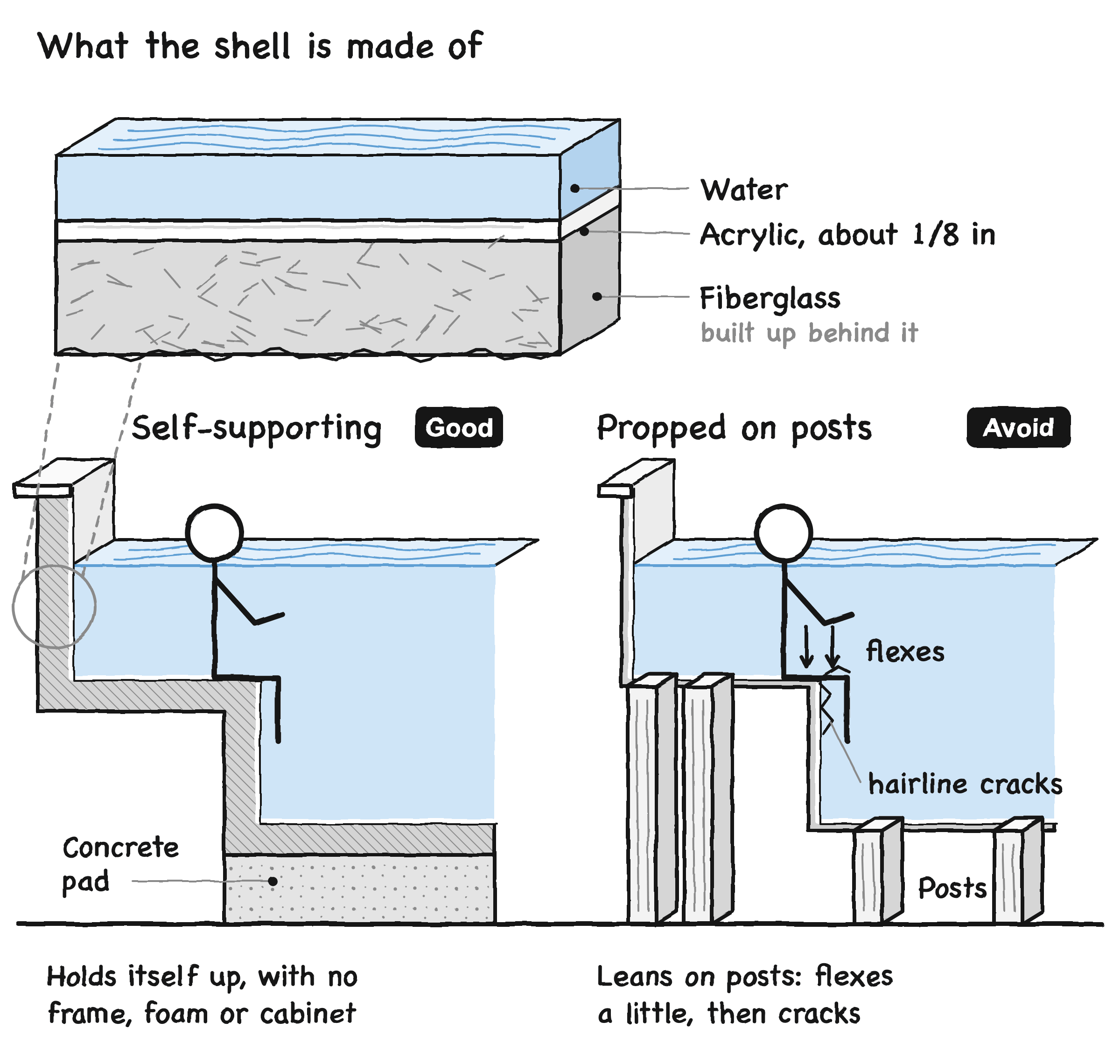
The pitchArctic backs its acrylic with heavy layers of filler-free fiberglass (it says about an inch, adding roughly 700 lb), so the shell holds itself up with no props underneath.
Our takeEven the independent reviewer that is harshest on Arctic rates its shell well. Arctic's pages disagree on whether the fiberglass is sprayed or hand-applied.
Who else has it: Fiberglass-backed acrylic is standard (Beachcomber, Marquis, Artesian); Arctic's heavy, self-supporting version is at the thick end.
The pitchCustom tubs come in Western red cedar with a 10-year cabinet warranty, and every panel comes off for full access to plumbing and equipment.
Offered on: Custom series (cedar); composite cabinets offered
Our takeFull access follows from the foam-free cabinet, and the 10-year cedar warranty on Custom is in writing. Hydropool notes its own wood cabinets aged worse than synthetic ones; Arctic also sells composite cabinets.
Who else has it: Most acrylic brands have moved to synthetic cabinets; competitor Hydropool calls Arctic one of the few companies still offering real wood, and Nordic's cedar option carries only a 1-year warranty.
The catchReal cedar means real upkeep: it needs periodic re-staining (an Arctic parts store says yearly), and the 10-year cedar warranty excludes surface staining and fading. Arctic's Custom warranty covers cedar against material defects but not surface stain or fading, and Arctic's blog says how often to re-stain depends on how much sun the tub gets. $49.95 per gallon of cedar stain, enough for 2-3 applications (Arctic Spa Store)
The pitchArctic sells itself as the cold-climate hot tub, designed in Alberta for hard winters, and has claimed to be the only brand designing tubs specifically for cold weather.
Our takeArctic's cold-weather features are real, but 'only Arctic' plainly isn't true, and Arctic publishes no independent energy or freeze tests. Its maker also lists a production plant in Spokane, Washington, besides Alberta.
Who else has it: Cold-climate positioning is widespread: fellow Canadian makers Beachcomber and Hydropool also sell hard on heat retention, and a Nordic dealer pitches Nordic's cold-climate performance.
The catchReal cedar means real upkeep: it needs periodic re-staining (an Arctic parts store says yearly), and the 10-year cedar warranty excludes surface staining and fading.
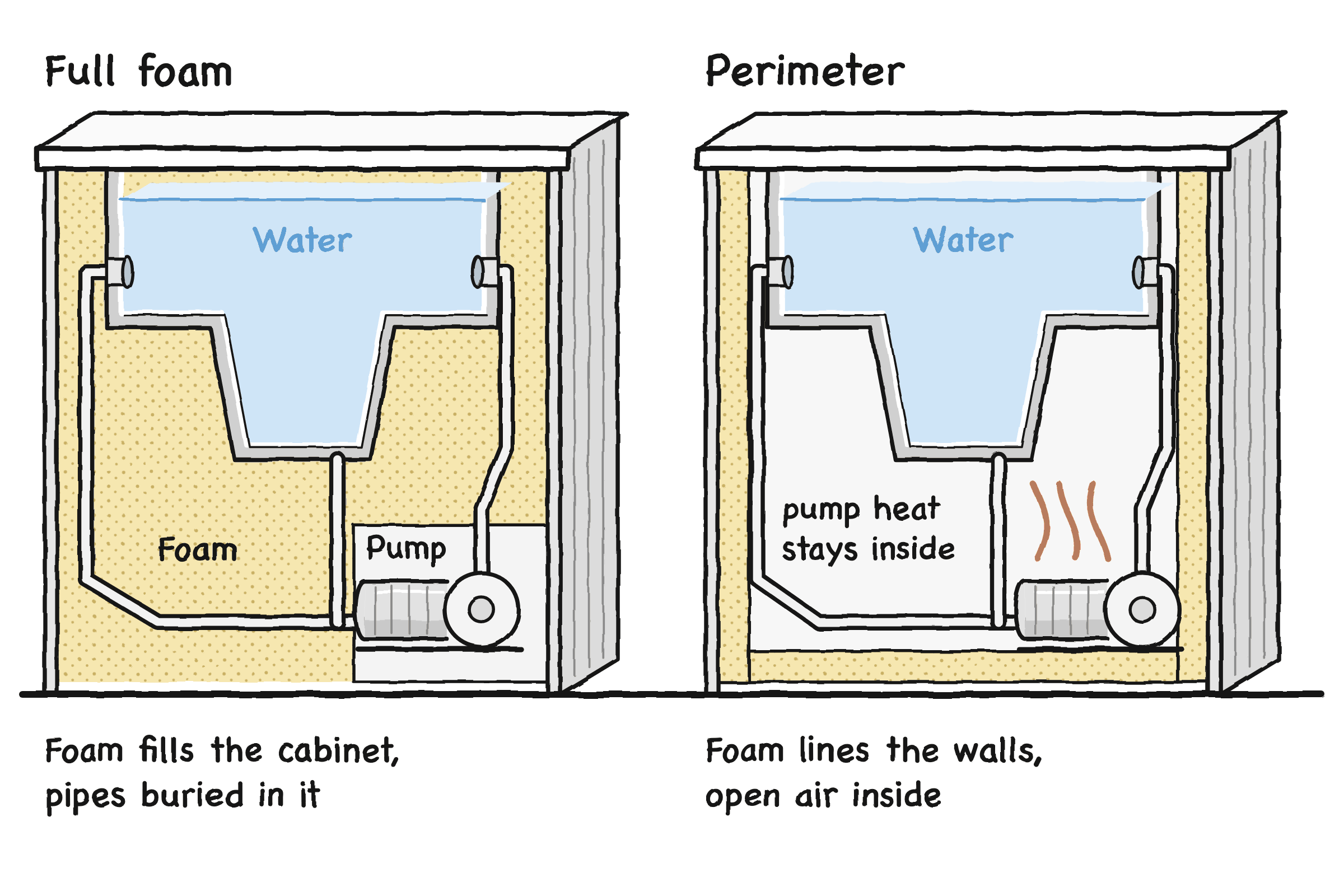
The pitchInstead of foam-filling the cabinet, Arctic lines the walls and floor with 3-4 inches of dense foam and lets heat from the pumps warm the water. Reps add that a tub held about 5 days at -20°C without power before freezing, and that foam-free plumbing is easy to repair.
Our takeCapturing motor heat is physically real, and even competitor Hydropool credits Arctic's roughly 3-inch wall-and-floor foam with trapping heat. But the 5-day figure is Arctic's own unpublished test, its feature page claims heat loss is eliminated, and no standby-watt comparison is offered.
Who else has it: Most premium brands fill the cabinet with foam (Jacuzzi calls full foam the gold standard). Hydropool's thermal-blanket design is the closest comparable, and Beachcomber's Hybrid4 does the opposite, moving equipment outside the insulated space.
The catch (partly true)The efficiency and freeze claims are Arctic's own: it calls its tubs CEC-compliant but publishes no standby watts, and its 'about 5 days at -20°C before freezing' figure has no stated test method. Arctic's safety-approvals page claims CEC compliance without any figures, and its insulation blog gives the 5-day claim without conditions; recapturing motor heat is physically real, but nothing published lets a buyer compare it with full foam.
Often said, not trueAn independent review site says the perimeter design traps so much heat around the pumps that it shortens their life. The review gives no pump-failure data and we found none elsewhere; Arctic covers pumps for 5 years on Custom and 3 on Classic, the same as its other equipment.
The pitchSpa Boy's sensors watch chlorine and pH and drive the Onzen salt cell to make chlorine automatically, with alerts on your phone; a newer Smart pH add-on adjusts pH too.
Offered on: Spa Boy models (Arctic lists Summit XL, Summit, Klondiker, Kodiak, Tundra, Yukon, Cub and Arctic Fox)
Our takeThe automation is real. But a salt tub is still a chlorine tub, salt cells push pH up (hence the add-on), and Arctic's 'exclusive' label applies only to its own product.
Who else has it: Monitored salt systems now exist elsewhere: Hot Spring's FreshWater Salt with FreshWater IQ sensing and dosing, and Master Spas' Master Clear Smart Cell; Cal Spas' Cal Salt runs on a timer instead. Spa Boy was in trade press by 2016, earlier than most.
The catchSpa Boy has running costs: the salt-cell electrode must be replaced every year and carries only a 30-day warranty, the chlorine/pH probe lasts about 12-24 months, and only Arctic Pure salt keeps the warranty valid. Arctic's warranty says the user-replaceable electrode needs annual replacement and must be used with Arctic Pure salt; an Arctic dealer puts probe life at 12-24 months before readings drift. Electrode $189.79 (Premier Pool & Spa) to $249 (Arctic Spa Store) a year; ORP/pH probe $195.92 (Premier Pool & Spa) or CAD $245 (Arctic Spas Ontario)
The pitchArctic's SMC fiberglass floor can't rot or let in pests and, reps say, replaces a concrete pad: set the tub on firm, level ground and save $800-$2,000 in site work.
Offered on: Custom and Classic series (standard or optional varies by Arctic page)
Our takeIt is a genuine moisture-proof base, with a lifetime warranty on Custom tubs (3 years on Classic). 'No site prep' still means firm, level ground, and Arctic's own pages disagree on whether it is standard or an upgrade.
Who else has it: Sealed, rot-proof bases are common (Marquis DuraBase and Artesian's ABS pans, Bullfrog's ABS EnduraFrame); Arctic's is a thicker structural fiberglass platform.
The catch (partly true)The 'no pad needed' pitch and the warranty don't match: the lifetime Forever Floor coverage on Custom tubs applies only if the tub sits on a solid level pad, Classic floors get 3 years, and Core tubs get a different floor with 3 years, parts only. Arctic's article says the floor needs only firm, level ground and saves $800-$2,000 in site work, but its Custom warranty conditions the lifetime term on a solid level pad without defining one.
The pitchThe Mylovac cover is vacuum-sealed with double-density foam and a metal insert, pitched as one of the most energy-efficient covers made.
Our takeA thick, well-sealed cover genuinely matters; the CEC names insulation and the cover as the biggest energy savers. Arctic gives no R-value or test, though, and its claim that heat loss becomes non-existent can't be literally true.
Who else has it: Thick tapered covers are standard, and Marquis (Weathershield) and Artesian (All Seasons Shield) also sell upgraded covers.
A BBB letter grade rates how a company handles complaints, not how happy owners are, and complaint counts grow with the number of tubs a company sells.
What decides whether a tub lasts is mostly hidden under the shell. Here is what Arctic Spas publishes about it, and where it publishes nothing, we say so.
The full Arctic Spas build-quality report: all 8 checks, drawn and ranked →
Not published Self-supporting shell
Arctic Spas doesn't publish this.
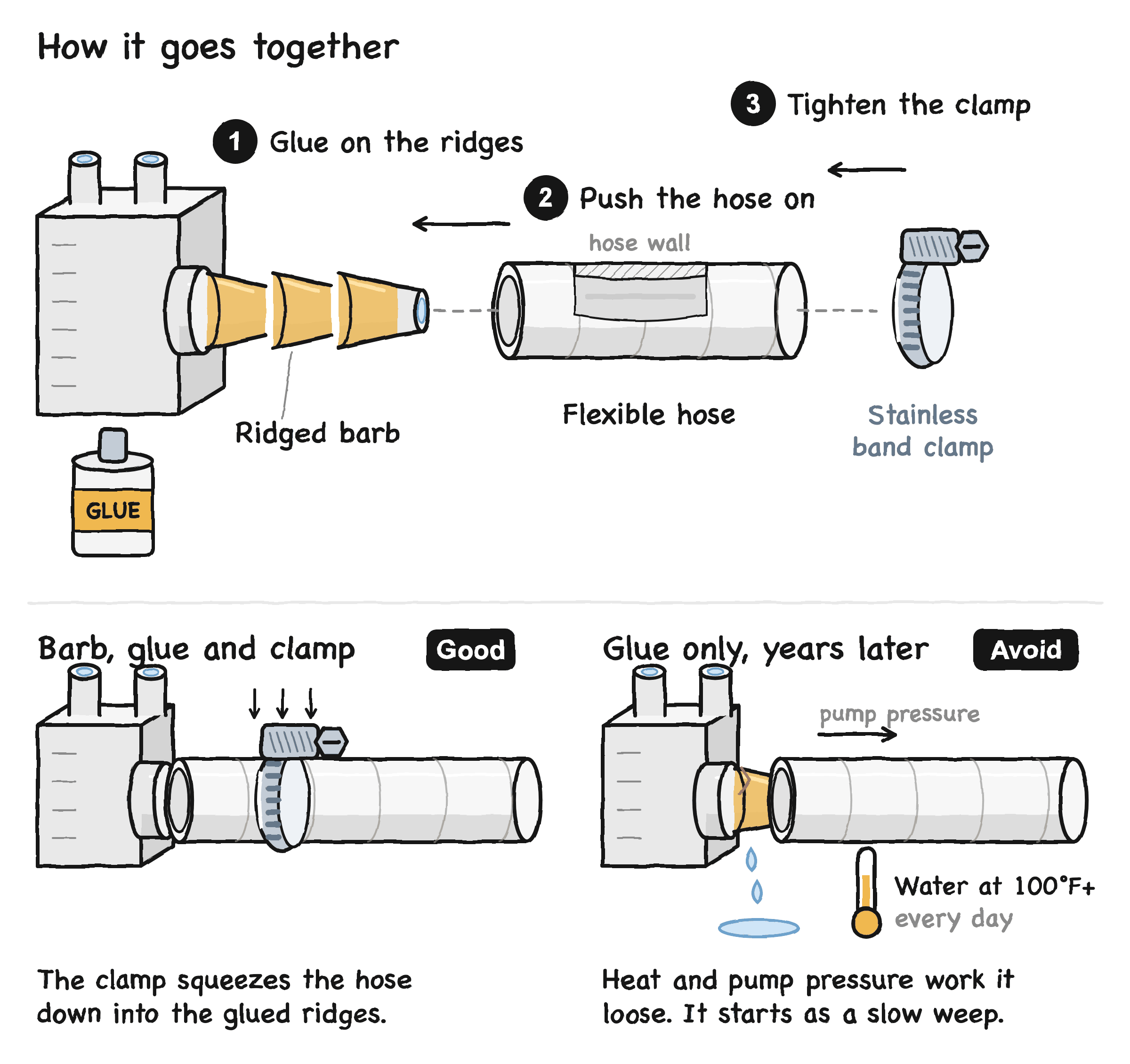
Partly Clamped plumbing
An authorized dealer says Arctic's Reflex Torsion hose glues over rigid PVC fittings; Arctic says jets are set with a plastic weld gun.
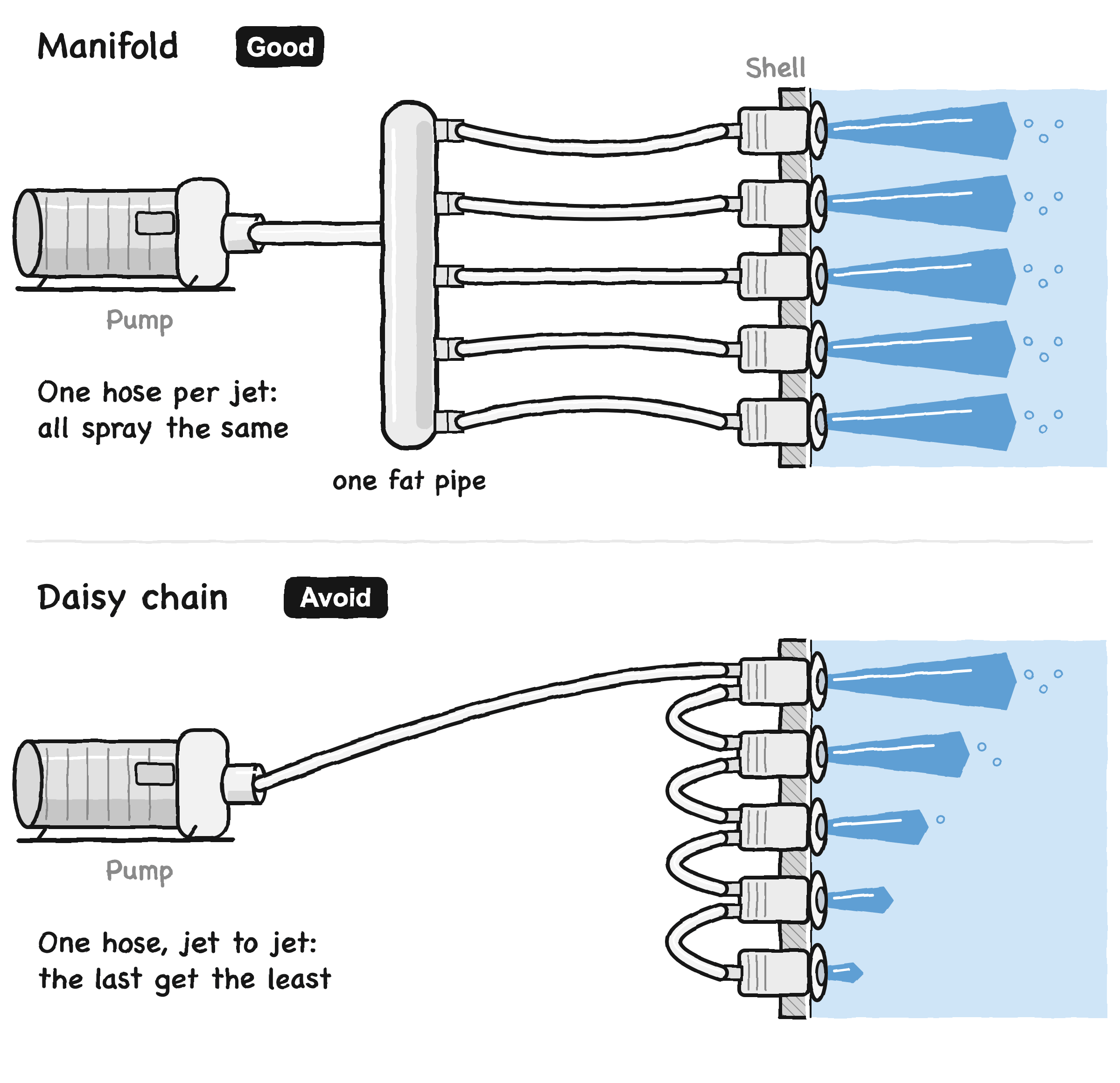
Not published Manifold-fed jets
Arctic Spas doesn't publish this.
Not published Standard parts
Arctic Spas doesn't publish this.
Not published Compression-fitted jets
Arctic Spas doesn't publish this.
Not published Adjustable jets
Arctic Spas doesn't publish this.
Not published Service network
Arctic Spas doesn't publish this.
Yes American made?
Thorsby, Alberta: Head office and main production facility, 45 minutes southwest of Edmonton. Breton, Alberta: Production plant listed by Blue Falls. Spokane, Washington: U.S. production plant listed by Blue Falls.
bluefallsbrands.com ↗bluefallsbrands.com ↗bluefallsbrands.com ↗
Founded in 1994 in Alberta, Canada. Changed hands once; owned today by a private company.
Arctic Spas says it was founded in 1994. Its owners say they grew up on farms and in small towns in western Canada.
Ownership last checked September 2026. Who owns every hot tub brand.
Warranty by part, the numbers across the lineup, and where every fact comes from.
Read the warranty card before you sign: what labor is covered after year one, and whether it moves to a second owner.
Builds here today
Listed, but not confirmed as a working plant today
Every figure on the page also carries its own source dot. Specs come from Arctic Spas' own documents.
Tell us which swim spas you like. We send you the price range, then introduce you to one Arctic Spas dealer near you, who reaches out knowing what you expect to pay.